


The app industry evolves at an incredible pace, with new technologies, frameworks, and features emerging almost daily. Businesses are constantly exposed to headlines promoting the next breakthrough, making it difficult to separate genuine innovation from short-lived excitement.
While staying informed is essential, adopting every new idea can result in costly products packed with features that offer little real value to users.
The most successful digital products are built around solving meaningful problems, not simply keeping up with the latest buzz. Understanding which app industry trends are shaping the future, and which are likely to fade, is becoming an important part of strategic decision-making.
This article explores today's web and mobile app development trends to help businesses identify lasting opportunities and make smarter investments in future-ready applications.
Why Chasing Every Trend Can Hurt Your App
Developing an app around the latest trend rather than genuine user needs often creates more problems than it solves.
In the race to stay ahead, businesses may add unnecessary features that complicate the user experience, increase development costs, and make applications harder to maintain. Others invest in emerging technologies to solve problems their customers do not actually have, resulting in products that struggle to gain traction.
Research consistently shows that successful products are built on a deep understanding of user behavior, with customer feedback and validation guiding development decisions rather than assumptions or industry hype.
Instead of asking, "What technology should we use?" leading product teams first ask, "What problem are we solving?"
This user-first approach helps create intuitive applications that deliver lasting value, adapt to changing expectations, and remain relevant long after fleeting trends have disappeared from the spotlight.
What Makes a Technology Trend Worth Investing In?
Not every emerging technology deserves a place in your product roadmap. Before investing time and resources into the latest innovation, it's important to evaluate whether it offers lasting business value or simply reflects short-term market excitement.
The following questions provide a practical framework for making smarter technology decisions.
Does it solve a genuine user problem?
The strongest innovations address real customer pain points rather than creating solutions for problems that don't exist. For example, ride-sharing apps like Uber succeeded because they simplified booking, tracking, and paying for transportation, not because they introduced new technology for its own sake.
Is adoption growing consistently?
Look beyond headlines and consider whether businesses and consumers are embracing the technology over time. Artificial intelligence is a good example, with steady adoption across industries through practical features such as personalized recommendations, customer support, and workflow automation.
Does the supporting technology already exist?
A promising idea is far more viable when the infrastructure behind it is mature. Cloud computing, reliable APIs, and scalable development frameworks have enabled services like Spotify to deliver seamless music streaming to millions of users worldwide.
Can it improve the customer experience?
Every investment should make an app easier, faster, or more enjoyable to use. Features like biometric authentication have become widely adopted because they reduce friction while improving security, creating a better experience for users.
Will users still value it several years from now?
Sustainable trends continue delivering value as expectations evolve. Push notifications, when personalized and used thoughtfully, remain an effective engagement tool because they provide timely, relevant information instead of becoming distractions.
4 Mobile App Technology Trends That Are Reshaping Development
The most influential mobile app technology trends are not simply introducing new capabilities. They are fundamentally changing how businesses build applications that deliver long-term value.
Rather than chasing novelty, organizations are investing in technologies that improve usability, scalability, and adaptability, making these mobile app development trends far more likely to endure.
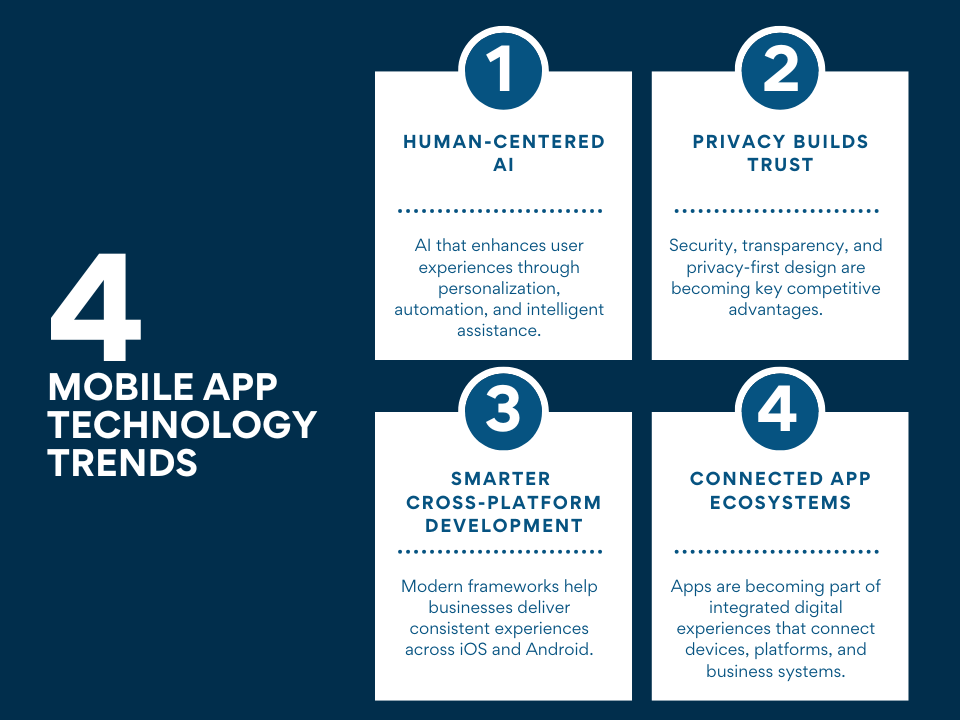
1. AI That Improves User Experience Instead of Replacing It
Artificial intelligence has moved beyond being a headline feature and is becoming a practical tool for enhancing everyday user experiences. Instead of replacing human decision-making, AI is increasingly working behind the scenes to make apps feel more intuitive.
Streaming platforms recommend content based on viewing habits, navigation apps predict traffic conditions before users encounter delays, and shopping apps suggest products that align with previous purchases and browsing behavior.
Intelligent search capabilities also help users find relevant information faster by understanding natural language rather than relying on exact keywords.
Automation is another area where AI is proving its value, handling repetitive tasks such as scheduling appointments, organizing emails, or categorizing expenses so users can focus on higher-value activities.
The common thread across these applications is that AI succeeds when it quietly removes friction rather than drawing attention to itself. As machine learning models continue to improve, businesses that use AI to simplify experiences instead of adding unnecessary complexity are likely to see stronger user engagement and long-term adoption.
2. Privacy and Security Are Becoming Competitive Advantages
Users are more aware than ever of how their personal information is collected, stored, and shared. As a result, privacy and security have evolved from technical requirements into important factors that influence customer trust and brand reputation.
Today's successful applications prioritize transparent permission requests, explaining why data is needed rather than overwhelming users with vague prompts. Secure authentication methods such as biometrics, multi-factor authentication, and passkeys also provide stronger protection while making the login process more convenient.
Privacy-first design is becoming equally important, encouraging developers to collect only the information necessary for an app to function effectively. At the same time, businesses must navigate an expanding landscape of data protection regulations, making compliance an essential part of product planning rather than an afterthought.
Organizations that demonstrate a genuine commitment to protecting user data are increasingly differentiating themselves in crowded markets where trust can influence download decisions just as much as features or pricing.
3. Cross-Platform Development Continues to Mature
Cross-platform development has evolved significantly over the past few years, making it possible to deliver high-quality experiences across both iOS and Android from a shared codebase.
Frameworks such as Flutter and React Native now provide stronger performance, richer user interfaces, and access to native device capabilities than ever before. While there are still situations where native development is the better choice, particularly for highly specialized applications, cross-platform development has become a strategic option for many businesses looking to launch faster while maintaining consistent user experiences. It also simplifies ongoing maintenance, allowing updates and new features to be rolled out more efficiently across multiple platforms.
Rather than viewing cross-platform development purely as a way to reduce costs, organizations increasingly recognize it as a way to improve development agility, accelerate time to market, and ensure product consistency without sacrificing quality.
4. Connected Digital Ecosystems Are Replacing Standalone Apps
Modern applications rarely operate in isolation. Instead, they function as part of broader digital ecosystems that connect users, devices, and business systems through seamless integrations.
Cloud platforms allow information to remain synchronized across multiple devices, while APIs enable apps to exchange data with payment gateways, customer relationship management platforms, mapping services, and countless other digital tools.
Wearable technology and smart home devices have further expanded these ecosystems, allowing users to move effortlessly between smartphones, watches, fitness trackers, vehicles, and connected appliances.
Within organizations, enterprise software integrations help eliminate manual processes by connecting mobile applications with inventory systems, accounting platforms, and internal workflows.
This interconnected approach enables businesses to create more flexible and scalable digital experiences that adapt while customer expectations and technologies continue to evolve, making ecosystem thinking one of the defining characteristics of modern app development.
The Future of Mobile App Development Is More Human Than Ever
While technology continues to evolve, the future of mobile app development will be defined less by the tools developers use and more by the experiences they create. The most successful apps are those that fit naturally into people's lives, helping users accomplish tasks quickly, confidently, and without unnecessary effort. When an app simply works, users rarely think about the technology behind it. Instead, it becomes a trusted part of their daily routine.
This human-centered approach is built on several key principles.
- Intuitive user experiences that make navigation feel effortless.
- Accessibility that enables people with different abilities to use the app confidently.
- Inclusive design that considers diverse users, devices, and environments from the outset.
- Reduced friction by minimizing unnecessary steps and simplifying common tasks.
- Meaningful personalization that adapts to user preferences without becoming intrusive.
- Emotional connection and trust through consistent performance, transparent communication, and respect for user privacy.
As user expectations continue to rise, the apps that stand the test of time will be those that prioritize people over novelty, creating experiences that feel natural, reliable, and genuinely valuable every time they are used.
Mobile App Monetization Trends 2026: Building Revenue Without Sacrificing User Trust
As businesses explore mobile app monetization trends 2026, the focus is shifting away from maximizing short-term revenue at any cost. Instead, successful apps are generating sustainable income by creating experiences that users genuinely value. Aggressive paywalls, excessive advertising, and manipulative tactics may produce quick returns, but they often damage user trust and increase churn. Modern monetization strategies recognize that long-term profitability depends on building lasting relationships with users by delivering consistent value over time.
There are several approaches that are shaping this evolution.
- Subscription models are becoming more flexible: Subscription services are moving beyond one-size-fits-all pricing. Many apps now offer multiple tiers, monthly or annual billing options, and feature-based plans that allow users to choose the level of service that best suits their needs. This flexibility makes premium features more accessible while helping businesses attract and retain a broader customer base.
- Value-driven in-app purchases: Users are more willing to make purchases when they clearly enhance the app experience rather than remove artificial limitations. Whether unlocking additional productivity tools, purchasing premium content, or accessing advanced customization options, successful in-app purchases provide meaningful benefits that users perceive as worthwhile investments.
- Ethical advertising: Advertising continues to play an important role in free apps, but the emphasis is shifting toward quality rather than quantity. Relevant, well-placed ads that respect the user experience are replacing disruptive formats such as frequent pop-ups or unavoidable interruptions. At the same time, greater transparency around data collection and ad personalization is helping businesses strengthen user confidence.
- Freemium that encourages long-term engagement: The freemium model remains effective when free users receive genuine value before being asked to upgrade. Instead of limiting core functionality too aggressively, many successful apps allow users to experience the product's benefits first, making premium upgrades feel like a natural next step rather than a forced purchase.
Ultimately, the most sustainable monetization strategies are built on trust. When users consistently receive value, enjoy a positive experience, and feel respected throughout their journey, they are far more likely to remain engaged, recommend the app to others, and invest in premium features or services over the long term.
How Businesses Can Separate Hype from Long-Term Opportunity
With new technologies emerging at a rapid pace, making informed investment decisions requires looking beyond industry buzz. Before committing to a new feature or platform, decision-makers should ask a few key questions.
- Does it solve a genuine customer need?
- Will it improve user retention or engagement?
- Can it scale as the business grows?
- Does it support long-term business objectives?
- Is there a clear and measurable return on investment?
- Will users genuinely notice and appreciate the improvement?
Answering these questions helps shift the focus from adopting technology for its own sake to investing in innovations that create measurable business value and deliver meaningful experiences for users.
Why Successful Apps Are Built Around People, Not Trends
Technology will continue to advance, and today's innovations will eventually be replaced by something newer. At the same time, user expectations will continue to evolve as people look for faster, simpler, and more personalized digital experiences.
Despite these changes, the foundation of every successful app remains remarkably consistent. The strongest applications solve meaningful problems, provide intuitive experiences, adapt as user needs change, and earn trust through reliability, transparency, and continuous improvement.
Rather than chasing every new development, businesses that invest in thoughtful, user-centered app development create products with lasting relevance.
By balancing innovation with a genuine understanding of the people they serve, they are better equipped to embrace future opportunities while delivering value that extends well beyond the latest technology trend.
Build Future-Ready Apps with AppIt
Building an app that delivers lasting value starts with making the right decisions long before development begins.
At AppIt, every project is guided by a clear understanding of your users, your business objectives, and the challenges your app is designed to solve. This strategic foundation enables the team to evaluate emerging technologies based on their real-world value rather than their popularity.
By combining deep technical expertise with a human-centered approach to design and development, AppIt creates custom applications that are intuitive, scalable, and built for long-term success. Whether that means incorporating AI where it enhances the user experience, developing secure and future-ready architectures, or creating seamless cross-platform solutions, every decision is driven by what will provide the greatest benefit to your business and your users.
If you're ready to build an application that solves meaningful problems today while remaining adaptable for tomorrow, partner with AppIt to create a solution designed for sustainable growth, lasting performance, and exceptional user experiences.