Choosing an Android development partner in 2026 requires a different evaluation than it did a few years ago.
Building a successful app has never been just about writing code. Architecture, user experience, security, testing, integrations, deployment, and long-term maintenance all influence whether an application remains reliable and scalable after launch.
What has changed is how AI can support parts of that process.
AI-assisted development and increasingly agentic workflows can accelerate coding, testing, migration, and other technical tasks, but speed alone is not a measure of quality. A development company can use AI extensively and still produce poorly architected software, while an experienced engineering team can use AI selectively to work more efficiently without lowering its standards.
The goal, then, is not to find the partner using AI most. It is to find an Android development company that combines strong engineering judgment with the ability to use AI-driven workflows responsibly and effectively.
What Does an Android Development Company Actually Do?
An Android app development company does far more than build screens and write code. A capable partner supports the technical and product decisions that take an idea from initial concept, through to launch and ongoing improvement.
From Product Idea to Deployed Application
A typical Android development lifecycle includes:
- Discovery and requirements: Defining business goals, users, features, technical requirements, and project scope.
- Technical architecture: Selecting the appropriate architecture, technologies, APIs, and infrastructure for a maintainable application.
- UX/UI implementation: Translating user needs and designs into intuitive, responsive Android experiences.
- Development: Building, integrating, and refining the application's functionality.
- API and third-party integrations: Connecting the app to backend systems, payment platforms, analytics, authentication services, and other required tools.
- Testing and security: Identifying functional, performance, compatibility, and security issues before release.
- Google Play deployment: Preparing the application for release and managing the technical requirements of distribution.
- Monitoring, updates, and maintenance: Addressing bugs, dependencies, platform changes, security issues, and future feature requirements after launch.
Ultimately, development is only one part of the relationship. Your partner should be capable of supporting the application throughout its lifecycle.
Native Android vs Cross-Platform Development
Native Android development can provide deeper access to Android APIs and platform-specific capabilities. Meanwhile, cross-platform frameworks can be practical when a product needs to support multiple platforms from a shared codebase.
The right choice depends on the application’s requirements, and not on a development company’s preferred technology.
Where AI Fits into Modern Android Development
AI-assisted tools can help developers generate or refactor code, write tests, explain unfamiliar code, and troubleshoot issues. On the other hand, more agentic workflows can handle multi-step tasks across a repository, run tests, and iterate on changes.
However, neither replaces architectural judgment, security review, product decisions, or human accountability.
What Does “AI-Ready” Actually Mean?
AI-ready should mean more than having access to the latest coding assistant. For an Android project, it applies both to how the development team works and how the resulting application is built.
AI-Ready Development Teams
A capable partner should be able to explain the following:
- Which AI tools they use: They should identify the tools and workflows involved rather than simply claiming to be “AI-powered”.
- What those tools do: AI might assist with code generation, refactoring, testing, documentation, debugging, or other repetitive tasks.
- Where humans remain responsible: Architecture, security decisions, technical tradeoffs, and final code approval should remain subject to qualified engineering judgment.
- How AI-generated work is validated: Generated code should go through the same testing, review, and quality controls as manually written code.
- How your data is protected: The team should have clear practices for handling proprietary source code, credentials, customer data, and other sensitive information.
- How results are measured: Look for evidence that AI improves delivery speed, quality, or efficiency rather than simply increasing the amount of code generated.
The question is therefore not just, “Do you use AI?” It is, “How do you control and validate it?”
AI-Ready Applications
AI readiness can also describe the application itself. Depending on the product, a future-ready architecture may include:
- clean API boundaries and well-structured data
- scalable backend infrastructure
- secure data handling, authentication, and authorization
- infrastructure capable of supporting AI services
- flexibility to integrate APIs, models, or intelligent features later.
Not every Android app needs AI. However, a strong, custom Android app development partner should avoid architectural choices that make future AI integration unnecessarily difficult.
Questions to Ask Before You Hire an Android Development Partner
When evaluating an Android development partner, it is important to ask which tools the team uses and where they fit into the development process. AI may support code generation, refactoring, testing, documentation, migration, debugging, or code review.
It is also worth asking whether the team primarily uses copilot-style assistance, where developers direct individual tasks, or more autonomous agentic workflows, where an AI system can perform multiple related steps across a codebase. In either case, ask how developers supervise these workflows and how generated changes are reviewed and validated before entering production.
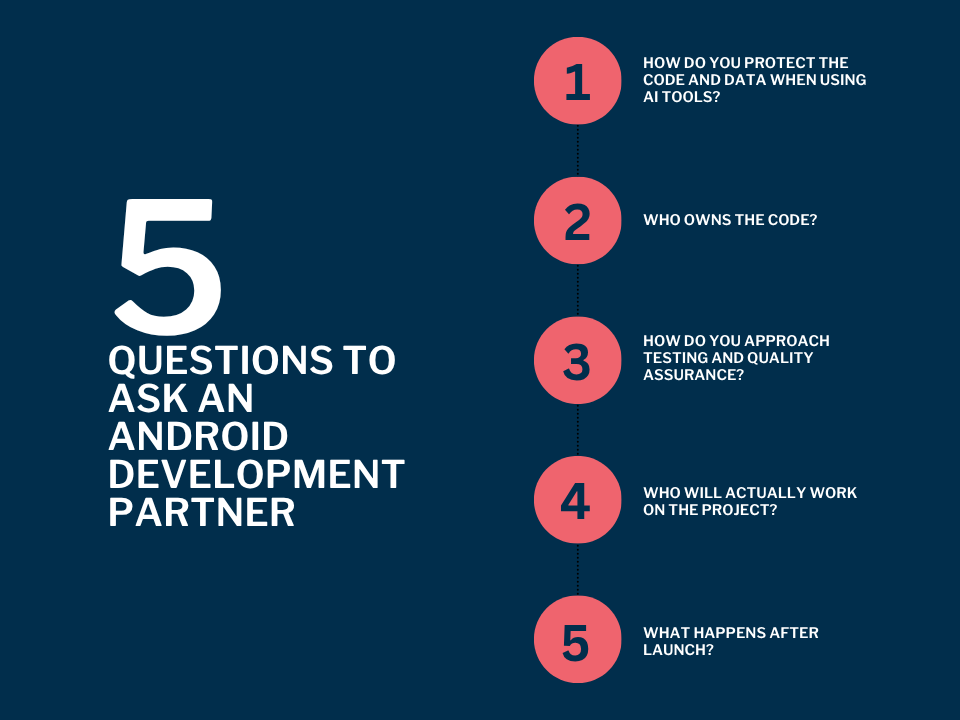
How Do You Protect Our Code and Data When Using AI Tools?
AI tools can interact with sensitive development information, so your partner should have clear safeguards around what enters those systems. Ask about:
- data retention and privacy policies
- access controls and permissions
- handling of passwords, API keys, and other credentials
- proprietary source code
- enterprise security requirements.
For enterprise mobile app development, this should be a standard part of the technical conversation, not an afterthought.
Who Owns the Code?
Before development begins, establish exactly what you receive at the end of the engagement. Clarify ownership and access to the following:
- Source code and repositories
- Technical documentation
- Build and deployment credentials
- Third-party accounts and services
- Intellectual property
You should not discover after launch that your business depends on the development company to access, modify, or deploy its own application.
How Do You Approach Testing and Quality Assurance?
Ask what happens between the code being written and it reaching users. A mature process may include:
- automated and unit testing
- integration and UI testing
- testing across relevant Android devices and versions
- regression testing
- security testing
- human code review.
AI can accelerate development, but it does not remove the need to verify that software behaves correctly.
Who Will Actually Work on My Project?
The sales team and the delivery team are not always the same. Ask about the developers’ experience, technical leadership, project management structure, communication process, and who has final responsibility for architectural decisions.
Also confirm that the team presented during the sales process is the team expected to deliver the project.
What Happens After Launch?
An app requires ongoing attention as Android evolves. Ask whether your partner provides Android app development services that cover:
- Bug fixes and performance issues
- Android OS and dependency updates
- Security patches
- Google Play requirements
- New features and enhancements
- Monitoring and ongoing technical support
A strong partner should have a plan for the application after it reaches users, not just a plan for getting it there.
How to Compare Android Development Proposals
Once you have several potential partners, comparing proposals requires more than putting their prices side by side. Look at what each proposal actually commits to the development team delivering, how the commercial model fits your project, and whether the partner’s experience matches your technical requirements.
- Look beyond the headline price: A useful proposal should clearly define what is included and excluded, along with deliverables, milestones, estimated timelines, project assumptions, third-party costs, and post-launch support. This makes it easier to identify differences between seemingly similar bids and reduces the risk of unexpected costs later. A lower initial quote is not necessarily better if important services are excluded.
- Fixed-fee vs time-and-materials: Fixed-fee projects can provide greater budget predictability and work well when requirements and scope are sufficiently defined. However, significant changes may require additional fees or change orders. Time-and-materials engagements offer greater flexibility when requirements are expected to evolve, with costs based on the team's actual effort. They require closer budget monitoring throughout development.
- Look at the portfolio, not the logo wall: A long list of recognizable clients does not necessarily demonstrate relevant experience. Look for applications with comparable complexity, integrations, security requirements, or expected user volumes, along with evidence of measurable outcomes. An android app development company does not need experience in your exact industry if it can demonstrate the technical capabilities your application requires.
What Changed After Google I/O 2026?
Google I/O 2026 highlighted a broader shift in Android development: AI is moving beyond autocomplete and isolated coding assistance toward more agentic workflows that can handle multiple steps of an engineering task.
Depending on the workflow, AI agents can work with Android CLI-based tools, assist with migrations, propose repository-level code changes, support code reviews, or run tests and help investigate failures.
For businesses hiring an Android development partner, however, the important question is not how many AI tools a team uses. It is how intelligently those tools are incorporated into the development process.
A capable partner should be able to explain which tasks AI can accelerate, which still require experienced developers, and how AI-generated changes are reviewed before they are accepted. They should also be transparent about whether these workflows can affect project timelines or android app development cost, and how the team handles incorrect or unreliable AI-generated decisions.
Red Flags in an Android Development Proposal
A proposal can look impressive while leaving important questions unanswered. Before choosing a partner, watch for signs that suggest the team is prioritizing sales language, speed, or convenience over sound engineering and transparent delivery.
- “AI-powered” with no explanation: If a proposal repeatedly mentions AI but cannot identify the tools, workflows, safeguards, or measurable benefits involved, treat the claim as marketing rather than technical evidence.
- Unrealistic timelines: AI can accelerate specific development tasks, but it does not eliminate discovery, architecture, testing, security reviews, integrations, platform requirements, or stakeholder feedback. A sophisticated enterprise application promised on an implausibly short timeline deserves scrutiny.
- No clear testing strategy: If a proposal emphasizes rapid AI-generated development but provides little detail about automated testing, device compatibility, security testing, regression testing, or human review, ask how quality will be verified.
- Unclear ownership or scope: Be cautious when proposals omit source-code ownership, provide vague deliverables, leave third-party costs undefined, lack a change-request process, or say little about post-launch support. These gaps can create expensive disputes later.
- One-size-fits-all technology: A credible partner should explain why they recommend a particular architecture, framework, backend, or AI approach for your project. If the same technical solution appears in every proposal, the recommendation may be driven by the vendor’s preferences rather than your application’s requirements.
What Does Android App Development Cost in 2026?
There is no single price for building an Android app. The cost of development depends on the product's scope, technical requirements, and level of ongoing support, so an estimate should be based on the specifics of your project rather than an industry-wide average.
What Drives Development Cost?
Feature count and complexity are major factors, but they are only part of the equation. UI/UX requirements, native versus cross-platform architecture, backend and API development, third-party integrations, authentication, security, real-time functionality, offline capabilities, AI features, device compatibility, testing, and ongoing maintenance can all affect the total investment.
How Can AI Affect Cost?
AI and agentic development do not automatically make an app cheaper. They can reduce developer time for well-defined tasks, potentially accelerating prototyping, migrations, test generation, documentation, debugging, and routine refactoring. However, architecture, security, product decisions, and validation still require experienced engineers. The benefit is greater efficiency, not eliminating skilled development work.
Get an Estimate Based on Scope
Rather than comparing generic price ranges, provide potential partners with your requirements and ask for a detailed estimate. A good proposal should show what is included, identify assumptions and exclusions, and explain how changes could affect the final cost. This gives you a much more meaningful basis for comparing custom Android app development partners.
Why Businesses Choose AppIt Ventures
If you're looking for an Android development partner that can handle more than the coding itself, AppIt Ventures brings the combination of engineering experience, mobile development expertise, and technical depth needed to support the full lifecycle of your application. We've launched more than 1,000 apps across a wide range of industries, giving our team experience with different business requirements, technical challenges, and product environments.
We believe that effective software development still depends on experienced engineers. Architecture, technical decisions, security considerations, testing, and code quality require professional judgment and an understanding of the business problem the software needs to solve.
We also understand that launching an app is only the beginning. Our custom software and mobile development experience allows us to build solutions with long-term maintainability and future growth in mind, whether you're developing a new Android product, modernizing an existing application, or building a larger enterprise solution.
If you're ready to explore your requirements, technical approach, timeline, and estimated Android app development cost, book a project call with us at AppIt.