Launching an app is a major milestone, but what happens once it launches often has a far greater impact on its long-term success. As user expectations evolve, business priorities shift, and technology continues to advance; applications require ongoing attention to remain effective, competitive, and aligned with organizational goals. Yet many businesses focus heavily on development while giving little thought to the maintenance strategy that will support their product in the months and years ahead.
The reality is that there is no universal approach to app maintenance. The right strategy depends on your business stage, growth plans, budget, and the complexity of your application.
In this article, we'll explore the factors that influence app maintenance costs, the most common maintenance models available, how to determine which approach best fits your business, and the warning signs that indicate it's time for a change.
Why App Maintenance Planning Should Start Before It Launches
Many businesses view launch day as the finish line, but in reality, it marks the beginning of a product’s long-term journey. That’s why app maintenance planning should be considered a core part of product strategy from the earliest stages of development.
Decisions made before launch, including architecture, integrations, technology selection, and scalability requirements can have a significant impact on future maintenance needs and costs.
Planning for app maintenance early also helps organizations create more accurate long-term budgets. Rather than being surprised by unexpected expenses after deployment, businesses can account for ongoing updates, performance optimization, platform changes, and future enhancements as part of their overall investment strategy. This leads to better financial forecasting and fewer operational disruptions.
Maintenance expectations can also influence development decisions. For example, building with flexibility and future growth in mind can reduce complexity and make future changes easier to implement.
When app maintenance and support are treated as an afterthought, businesses often face higher costs, technical challenges, and slower adaptation to changing market demands. A proactive approach helps protect both the product and the investment behind it.
Understanding the True Drivers Behind App Maintenance Costs
One of the biggest misconceptions about mobile app maintenance is that costs are determined by how much an app costs to build. In reality, app maintenance costs are influenced by a variety of factors that extend far beyond the initial development budget.
Two applications with similar development costs can have vastly different maintenance requirements depending on their functionality, technical complexity, and operational demands.
Some of the key factors that influence ongoing maintenance costs include the following.
- Integration complexity: Apps connected to multiple external systems, APIs, payment gateways, or business platforms typically require more ongoing oversight and updates.
- Number of users: As user bases grow, additional resources may be needed to maintain performance, reliability, and responsiveness.
- Infrastructure requirements: Cloud hosting, databases, servers, and storage solutions all contribute to ongoing operational expenses.
- Compliance obligations: Industries with strict regulatory requirements often demand more frequent reviews, updates, and testing.
- Third-party dependencies: External tools and services regularly release updates that may affect application functionality.
- Platform requirements: Maintaining compatibility across iOS, Android, and web platforms, often requires separate testing, optimization, and updates.
Understanding these factors helps businesses plan more effectively for long-term mobile app maintenance and avoid unexpected expenses as their applications evolve and scale.
The Three Most Common App Maintenance Models
Choosing the right maintenance model is one of the most important decisions businesses make after launching an application. While many organizations focus on development, the structure of their ongoing support can have a significant impact on costs, responsiveness, and the ability to implement future improvements.
The right model should align with the level of support required, the pace of planned updates, and the organization's operational goals.
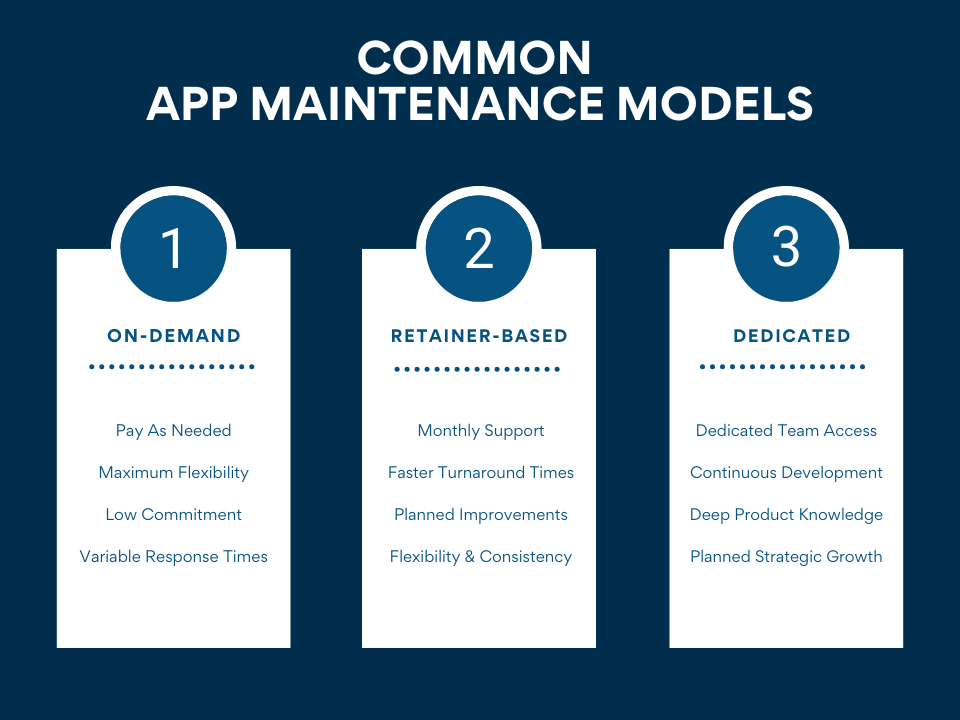
Most app maintenance services are delivered through one of three common approaches: on-demand maintenance, retainer-based maintenance, and dedicated maintenance resources.
On-Demand Maintenance
On-demand maintenance is a flexible approach where businesses request assistance only when work is required. Rather than committing to a monthly agreement or dedicated resources, support is provided on a project-by-project basis. This can include functionality enhancements, integration updates, design improvements, or technical adjustments that arise over time.
One of the biggest advantages of this model is its flexibility. Businesses maintain full control over when work is completed and how much they spend. There are no ongoing contractual commitments, making it an attractive option for organizations that experience fluctuating maintenance needs. It also allows decision-makers to prioritize work based on immediate business requirements.
However, because resources are not reserved, scheduling can sometimes be less predictable. Businesses may need to plan for larger requests or periods of increased demand. As a result, on-demand maintenance is often most effective when support requirements are intermittent rather than continuous.
Retainer-Based Maintenance
Retainer-based maintenance involves a recurring agreement that provides access to a predetermined level of support each month. Instead of submitting requests on an ad-hoc basis, businesses secure dedicated capacity that can be used for ongoing development, enhancements, and technical support activities.
The primary benefit of this model is predictability. Businesses know what level of support they have available and can budget accordingly. It also creates a more structured relationship between the client and provider, making it easier to prioritize work, plan updates, and address requirements as they emerge. Many organizations value the faster response times that often accompany retainer agreements, as resources are already allocated to support the application.
The key consideration is ensuring that the allocated support hours align with actual business needs. Organizations that anticipate regular updates and ongoing development often find this model provides an effective balance between flexibility and consistency. Many mobile app maintenance services are structured around retainer agreements because they provide a reliable framework for continuous support.
Dedicated Maintenance Resources
Dedicated maintenance resources provide businesses with access to specific individuals or teams that focus exclusively on supporting their application. Rather than sharing resources across multiple projects, the maintenance team develops an in-depth understanding of the product, its architecture, and its long-term objectives.
This model offers several advantages, including stronger continuity, greater efficiency, and improved alignment with business priorities. Because the team is deeply familiar with the application, they can execute work more effectively and contribute valuable insights regarding future enhancements and technical decisions.
The primary consideration is commitment. Dedicated resources typically require greater investment than other models and are most effective when there is a consistent volume of work to support. An experienced app maintenance company can help evaluate maintenance demands and determine whether dedicated resources will deliver the best long-term value for the business.
Matching Your Maintenance Approach to Your Business Stage
The most effective maintenance strategy depends largely on where your business is in its growth journey. An application that is still being validated in the market has very different requirements to one supporting thousands of users or integrating with multiple enterprise systems.
Understanding your current stage can help you choose a maintenance approach that supports both your immediate needs and future goals.
Startup Stage
Businesses in the startup phase are typically focused on launching a Minimum Viable Product (MVP), gathering user feedback, and validating product-market fit. Budgets are often lean, and priorities can shift quickly as new insights emerge.
At this stage, flexibility is usually more important than dedicated resources. Many startups benefit from an on-demand maintenance approach, allowing them to make adjustments and improvements as needed without committing to ongoing support costs before their product direction is fully established.
Growth Stage
As an application gains traction, maintenance requirements often become more consistent. User acquisition efforts increase, customer expectations rise, and feature expansion becomes a priority.
Businesses in this stage typically need regular enhancements, faster turnaround times, and a more structured approach to ongoing support.
Retainer-based maintenance can provide the balance of predictability and flexibility needed to support continued growth while ensuring development capacity is available when required.
Scale Stage
Organizations in the scale phase often manage complex applications that support large user bases, multiple integrations, and critical business operations. Performance, reliability, and ongoing optimization become strategic priorities.
Enterprise integrations, expanding functionality, and long-term product roadmaps require a higher level of consistency and technical expertise. Dedicated maintenance resources are often the most effective solution at this stage, providing continuous support and deep product knowledge that helps businesses scale confidently while maintaining a high-quality user experience.
Questions Every Business Should Ask Before Signing an App Maintenance Agreement
Not all maintenance agreements are created equal. While pricing is often a major consideration, the true value of an agreement lies in understanding exactly what level of support your business will receive when it matters most.
Asking the right questions upfront can help prevent misunderstandings, unexpected costs, and service gaps later. Whether you're evaluating your first provider or switching to a new app maintenance company, these questions can help you make a more informed decision.
Before signing any app maintenance and support agreement, consider asking the following questions, as the answers will often reveal how flexible, transparent, and scalable a maintenance partnership will be over the long term.
- What are the response times for critical issues? Understanding how quickly urgent problems will be addressed helps set realistic expectations.
- How are emergency requests handled? Not every issue can wait until regular business hours.
- Are unused hours carried over? This can significantly impact the value of a retainer agreement.
- Who owns the source code? Ownership should always be clearly defined and documented.
- How are maintenance requests prioritized? Understanding the process helps avoid delays and confusion.
- What reporting is provided? Regular reporting creates transparency and helps track progress.
- What happens if requirements increase? Your maintenance needs may evolve as your business grows.
Warning Signs Your Current App Maintenance Strategy Isn't Working
A maintenance strategy should help your application evolve alongside your business, not create obstacles that slow growth. However, many organizations continue with ineffective support arrangements simply because they have become accustomed to the challenges.
Recognizing the warning signs early can help prevent larger issues from developing and ensure your application remains a valuable business asset. If any of the following situations sound familiar, it may be time to reassess your current maintenance approach.
- Slow response times: When simple requests take days or weeks to receive attention, productivity suffers and important opportunities may be missed.
- A growing backlog of requests: If enhancement requests, improvements, and technical tasks continue to pile up faster than they are completed, it may indicate that your current support capacity is insufficient.
- Rising technical debt: Temporary fixes and postponed improvements can accumulate over time, making future development more difficult, time-consuming, and expensive.
- Delayed feature releases: When planned functionality repeatedly misses deadlines, your business may struggle to keep pace with changing customer expectations and market demands.
- Unpredictable costs: Frequent budget surprises often indicate a lack of planning, poor resource allocation, or a maintenance model that no longer aligns with business requirements.
- Internal team frustration: If stakeholders, managers, or employees are constantly chasing updates, following up on requests, or dealing with recurring issues, maintenance processes may not be functioning effectively.
While an occasional challenge is normal, persistent problems across multiple areas often signal a deeper issue. The goal of a strong maintenance strategy is not simply to keep an application running; it should provide the structure, responsiveness, and technical support needed to help the product move forward.
Regularly evaluating these warning signs can help businesses identify gaps before they begin affecting growth, customer satisfaction, or operational efficiency.
How AppIt Builds Flexible App Maintenance Services Around Business Needs
Every application is different, which is why AppIt believes there is no such thing as a one-size-fits-all maintenance solution. The support requirements of a startup launching its first product are vastly different from those of an established organization managing a complex digital ecosystem. As an experienced app development and app maintenance company, we work closely with our clients to understand their business objectives, growth plans, and technical requirements before recommending the most suitable maintenance approach.
Our goal is not simply to provide app maintenance and support when issues arise. We focus on building long-term partnerships that help businesses maximize the value of their digital products over time. Whether you require occasional assistance, ongoing support, or dedicated resources, our team can tailor a maintenance strategy that aligns with your goals and budget.
When partnering with AppIt, businesses gain access to:
- Customized maintenance plans designed around specific business needs and growth objectives.
- Support for organizations at every stage, from startups and MVPs to established enterprise platforms.
- A multidisciplinary team that includes developers, designers, QA specialists, and project managers.
- Strategic product guidance that helps prioritize initiatives and support long-term business goals.
- Scalable support models that can adapt as application requirements evolve.
- Proactive collaboration focused on helping products remain competitive and aligned with changing market demands.
Our approach to app maintenance services extends beyond technical execution. We help clients make informed decisions about their products, identify opportunities for improvement, and plan for future growth. By combining technical expertise with strategic thinking, we ensure that businesses receive the support they need today while preparing for tomorrow's challenges.
If you're looking for a trusted partner to deliver flexible mobile app maintenance services that grow with your business, contact us at AppIt today. Our team is ready to help you build a maintenance strategy that supports long-term success and keeps your application moving forward.