


Building an app isn’t just about coding or checking off features. It’s about solving genuine problems for real people. Many businesses start with a list of desired functionalities, only to end up with products that feel clunky, confusing, or unused.
The difference between an abandoned app and one that is indispensable lies in the choices you make before development begins: the questions you ask, the partners you select, and the way you define success.
This guide goes beyond the usual ‘what to look for’ advice, showing you how to hire a mobile app development company that doesn’t just build an app, but creates something meaningful, usable, and strategically aligned with your goals.
Start With the Problem, Not the App
Most companies begin the app journey by listing features (login screens, dashboards, integrations), before clearly defining the problem they’re trying to solve. That approach often leads to bloated, unfocused products that struggle to gain traction.
The most successful apps start somewhere else: with a sharp understanding of real user pain points.
- What frustration are you removing?
- What task are you simplifying?
- What need are you meeting better than anything else available?
Before reaching out to any agency, ask yourself:
- Who is this for?
- What specific problem do they face?
- Why hasn’t it yet been solved effectively?
The answers shape everything that follows. The best development partners won’t just ask what you want built; they’ll dig into why it matters, ensuring the final product is purposeful, intuitive, and genuinely useful.
Determine What You Are Hiring for
Before you hire a mobile app development company, it’s important to understand what you’re actually hiring for. Many businesses assume they simply need developers to build features, but there’s a significant difference between hiring coders and partnering with a full-service app team.
Developers can execute instructions, while true app partners bring strategy, user experience (UX) insight, and product thinking to the table.
The same applies to order-takers versus strategic thinkers. One builds exactly what you ask for, while the other challenges ideas, refines them, and ensures they’ll work in the real world. This is where many companies get it wrong. They focus on technical capability without considering whether the team can think critically about the product itself.
In reality, you’re not just hiring people to write code; you’re hiring a team to solve problems, shape user experiences, and help turn your idea into something people will actually use.
How to Hire Mobile App Developers Who Think Beyond Code
When considering how to hire mobile app developers, it’s easy to focus on technical skills and these are important, you can’t hire a developer who doesn’t have the necessary technical skill to execute your project. However, the real difference lies in how they think. If you want to hire a good mobile app developer, look beyond code and assess how they approach problems, users, and outcomes.
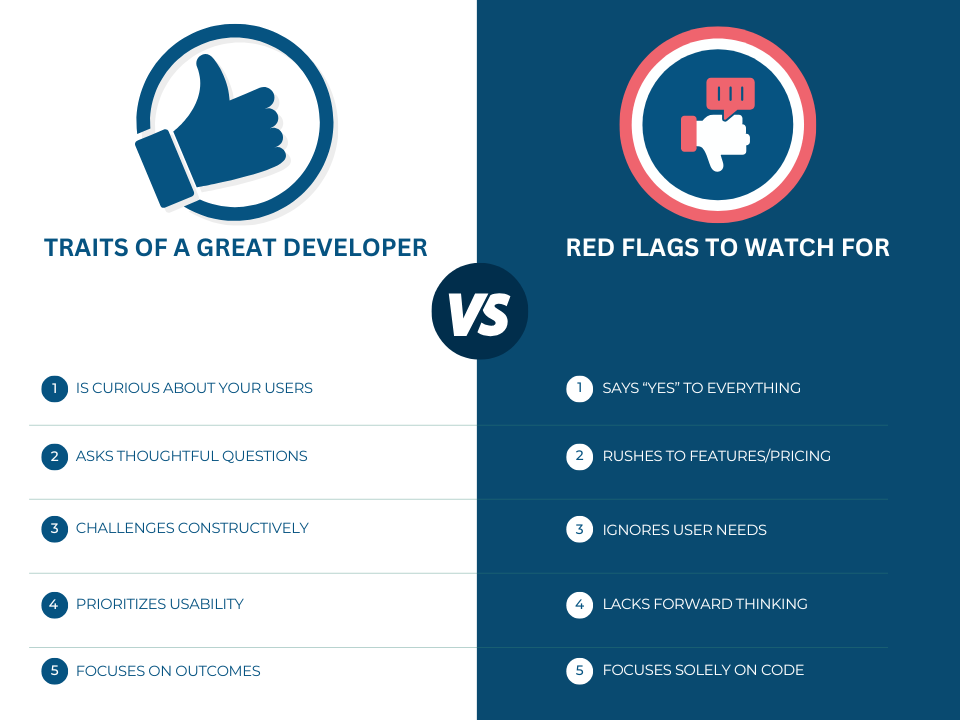
The right developers will:
- show genuine curiosity about your users and their behaviors,
- ask thoughtful questions that uncover gaps or assumptions,
- challenge your ideas constructively to improve the final product,
- prioritize usability, ensuring the app is intuitive and easy to navigate, and
- focus on outcomes; thinking about what the app achieves, not just what it includes.
On the other hand, watch out for red flags such as them:
- agreeing with everything you say without question,
- jumping straight into features, timelines, or pricing without context, and
- showing little interest in your users or business goals.
Knowing how to hire mobile app developers means choosing partners who think critically, not just those who can build what’s asked.
The Human Side of App Development and Why It Matters
The difference between an app that is merely downloaded and one that is actually used comes down to user experience. Functionality alone isn’t enough. People expect apps to feel intuitive, seamless, and enjoyable to interact with.
When user behavior and psychology are overlooked, the result is often frustration, high drop-off rates, and poor retention. Every extra step, confusing interface, or unnecessary feature adds friction that pushes users away.
Great apps, on the other hand, are designed around how people naturally think and behave. They simplify tasks, build on familiar habits, and remove obstacles before users even notice them.
This is where a human-first approach to app development becomes essential. By focusing on real interactions rather than just technical requirements, the end product becomes more than functional; it becomes something users return to because it simply works the way they expect it to.
Budgeting: What Does It Actually Cost to Hire an App Developer?
One of the most common questions businesses ask is: how much does it cost to hire app developer services? The answer isn’t straightforward, because pricing depends on a range of factors that shape the scope and complexity of your app.
Key elements that influence cost include the following.
- Complexity: Simple apps cost far less than feature-rich, highly interactive platforms.
- Platforms: Building for iOS, Android, or both (cross-platform) significantly impacts pricing.
- Design vs functionality: Custom UX/UI design and advanced features require more time and expertise.
- Backend systems: Integrations, databases, and APIs add layers of development.
It’s also important to understand that cheaper doesn’t always mean better, and a higher price tag doesn’t automatically guarantee success. The real focus should be on value: what you’re getting for your investment and how effectively the app solves your users’ problems.
For a more detailed breakdown, read AppIt’s in-depth guide to app development cost.
Choosing the Right Type of Partner
Choosing the right development partner is just as important as the idea itself. Different types of partners offer different strengths, and the best choice depends on your goals, budget, and the level of support you need throughout the process.
Freelancers
Freelancers are often the most cost-effective option and can work well for small, straightforward projects. They’re ideal when you have a clear plan and minimal complexity. However, they typically work alone, which can limit capacity, strategic input, and long-term support. If your project grows, scalability can become a challenge.
Small Agencies
Small agencies offer a balance between cost and expertise. You’ll usually get a more collaborative experience, with access to designers, developers, and some level of strategy. They’re a good fit for businesses looking for guidance without the overhead of a large firm. The downside is that resources may still be limited for highly complex or fast-scaling projects.
Dedicated Teams
When you hire a dedicated mobile app development company, you gain a focused team committed to your project. This option works best for businesses seeking ongoing collaboration, strategic input, and scalability, offering both depth and consistency throughout the app’s lifecycle.
Platform Decisions: Where Should Your App Live?
One of the key decisions you’ll need to make is where your app will live. Are you choosing to build your app for iOS, Android, or both?
Each option comes with its own implications for cost, development time, and audience reach. If your target users are primarily on one platform, it may make sense to focus your efforts there first, rather than stretching resources too thin.
In some cases, it’s better to hire Android mobile app developer expertise specifically, while in others, a cross-platform approach can offer efficiency and broader reach. Your choice will directly impact your budget, timeline, and how quickly you can go to market.
Instead of defaulting to ‘build it everywhere’, it’s important to think strategically about where your users are and how they behave. For a deeper dive into platform decisions, explore AppIt’s detailed guide on choosing the right development approach.
Communication, Process, and Transparency
Strong communication is often the difference between a smooth project and a frustrating one. No matter how technically skilled a team is, poor collaboration can lead to misunderstandings, delays, and disappointing results.
Good development partners will typically offer:
- regular check-ins to keep you informed and involved,
- iterative development, allowing for feedback and adjustments along the way, as well as
- clear milestones so you know what’s happening and when.
Before signing with any company, ask questions like:
- How often will we communicate, and through which channels?
- How do you handle feedback and changes during development?
- What does your process look like from start to finish?
Watch out for red flags such as vague answers, infrequent updates, or rigid processes that don’t allow for collaboration. Transparency and open communication should be non-negotiable.
Timeline Expectations: Why Great Apps Take Time
It’s natural to want your app launched as quickly as possible, but rushing the development process often leads to poor user experience and costly fixes later on. A realistic timeline accounts for more than just building features. It includes planning, design, testing, and refinement.
Great apps go through multiple iterations, where ideas are tested, feedback is gathered, and improvements are made before reaching the final product. Skipping or shortening these stages can result in an app that feels clunky or incomplete.
While speed to market is important, it should never come at the expense of quality and usability. The goal is to strike the right balance: moving efficiently while allowing enough time to create something stable, intuitive, and valuable to users.
In the long run, a well-developed app will always outperform one that was rushed to launch.
Questions Most Companies Don’t Ask (But Should)
Before you commit to a development partner, it’s worth asking a few deeper questions, which extend beyond timelines and pricing. These questions reveal how a team thinks and whether they’re focused on building something meaningful, not just functional.
- How do you validate ideas before building?
- How do you design for real user behavior?
- What happens after launch?
- How do you measure success?
These aren’t just nice-to-know details; they shape the entire outcome of your app. A team that can confidently answer them is far more likely to deliver a product that works in the real world, not just in theory.
What a Great App Development Partner Looks Like
Choosing the right app development partner is about more than finding someone who can write code; it’s about finding a team that will think strategically, collaborate closely, and help your idea succeed in the real world. The right partner treats your project as a shared mission, not a transaction.
Here’s what to look for when searching for a great mobile app development partner.
- Strategic: A top-tier partner doesn’t just build what you ask for, they help define what should be built. They understand your business goals, target audience, and long-term vision, and they guide design and functionality decisions to ensure the app supports your bigger picture. Strategy informs every stage of development, from wireframes to launch planning.
- User-focused: Exceptional apps are designed around the people who will use them. A user-focused team prioritizes usability, anticipates friction points, and creates experiences that feel natural. They conduct research, usability testing, and iterations to ensure your app resonates with its audience.
- Transparent: Communication and honesty are non-negotiable. Great partners provide clear timelines, share challenges openly, and give realistic expectations about what’s feasible, keeping surprises to a minimum.
- Collaborative: Development is a partnership. The right team invites your input, values feedback, and works with you every step of the way. They see you as part of the process, not just a client.
- Problem-solving: Features are only valuable if they solve real problems. The best teams question assumptions, suggest alternatives, and focus on outcomes rather than simply executing instructions.
- Technical capability: While strong technical skills shouldn't be the only deciding factor when making a decision they are essential. Your partner must be able to handle the complexity of your project, choose the right technologies, build scalable architecture, and deliver clean, reliable code. Technical expertise ensures your app performs well, adapts to future needs, and integrates smoothly with other systems.
- Good reviews: Research past work. Platforms like Clutch provide insight into client experiences, and speaking directly with former clients can reveal how a team collaborates and delivers.
If you want a team that prioritizes strategy, usability, and thoughtful problem-solving, AppIt is ready to guide your app from idea to impactful product. Ask better questions, seek smarter partners, and contact AppIt today to start building an app that works.