


Gamification has become a powerful tool in mobile app development, moving far beyond simple points and badges to actively shape user behavior and drive business outcomes. When applied correctly, app gamification can increase engagement, improve retention, and encourage meaningful actions that align with core business goals.
However, many implementations fail because they rely on surface-level features rather than strategy rooted in user psychology and intent. Effective gamification in apps is not about making an app feel like a game but rather about designing systems that guide behavior and sustain long-term engagement.
This article explores how to build gamification that actually works, from strategy and psychology to real-world examples and measurable success.
Why Most Gamification Fails
Despite its popularity, most gamification efforts fail to deliver meaningful results. In fact, up to 80% of gamified applications fail to meet their business objectives, largely due to poor design and strategy. While this statistic is more than a decade old, it is still found to be relevant and accurate.
The core issue is that many teams rely too heavily on surface-level tactics like points, badges, and leaderboards, assuming these elements alone will drive engagement. In reality, these features often create short-term spikes in activity but fail to sustain long-term behavioral change.
Another major flaw is the lack of alignment with business goals. Without clearly defined outcomes, gamification becomes decorative rather than strategic. Equally important is the misunderstanding of user motivation. When apps focus only on external rewards instead of intrinsic drivers (like progress, mastery, or purpose), users quickly lose interest.
This is where the distinction between decorative gamification and behavioral design becomes critical. Decorative gamification adds game elements on top of an experience, while behavioral design builds the entire app around influencing meaningful user actions. The difference between the two often determines whether an app succeeds or quietly fades away.
Defining Clear Business Goals Before You Build
Before implementing app gamification, it’s essential to define exactly what success looks like. Gamification in apps should never exist just to “make things more engaging”. It needs to support clear, measurable business outcomes. Without this foundation, even well-designed features can fail to deliver real value.
At its core, effective gamification starts by identifying the specific goals your app needs to achieve:
- Increase retention: Encourage users to return consistently through progress tracking or streaks.
- Drive conversions: Motivate users to complete key actions like purchases or sign-ups.
- Encourage habit formation: Reinforce repeated behaviors that become part of a user’s routine.
- Boost referrals: Incentivize users to invite others and grow your user base.
Once these goals are defined, the next step is mapping them strategically:
business goals → user actions → gamified mechanics
For example, a fitness app may focus on daily workouts, using streaks and milestones to build habits, while a fintech app might reward consistent saving or smart spending behaviors. Each approach differs because the desired user behavior (and ultimate business outcome) is not the same.
The Psychology Behind Effective App Gamification
Successful app gamification isn’t built on features alone—it’s grounded in human psychology. Understanding what truly motivates users allows you to design experiences that feel natural, engaging, and ultimately habit-forming. Research in behavioral science consistently shows that long-term engagement comes from deeper psychological drivers, not just surface-level rewards.
- Intrinsic motivation: Intrinsic motivation comes from within. Users engage because they find the activity itself rewarding. Studies by the American Psychological Association show that intrinsic drivers like curiosity, achievement, and purpose lead to more sustainable engagement than external rewards alone.
- Dopamine loops: Dopamine plays a key role in habit formation. Ultimately, small, consistent rewards and feedback loops encourage users to repeat behaviors, reinforcing engagement over time.
- Progress and mastery: Users are motivated by visible progress. The closer they feel to achieving a goal, the more likely they are to continue, a concept supported by the “goal-gradient effect”, studied by Columbia University. Progress bars, levels, and milestones tap directly into this behavior.
- Social validation: Humans are inherently social. Features like leaderboards, sharing achievements, or peer comparison leverage the need for recognition and belonging, increasing both motivation and retention.
- Emotional engagement: Ultimately, emotion drives action. Apps that create a sense of accomplishment, excitement, or connection outperform those that rely purely on rewards. Emotional engagement ensures users don’t just participate; they stay invested.
Core Gamification Systems That Drive Results
Effective app gamification is not about layering in isolated features; it’s about designing interconnected systems that guide user behavior over time. When these systems are intentionally structured, they create momentum, reinforce habits, and play a direct role in driving mobile app user engagement through gamification.
Instead of relying on one-off interactions, successful apps build ecosystems where each action leads naturally to the next, keeping users consistently involved.
Progression Systems
Progression systems are designed to give users a clear sense of advancement and achievement. By incorporating elements like levels, milestones, and streaks, apps create a visual representation of growth that encourages users to keep going.
This system taps into the psychological need for completion and forward movement. When users can see how far they’ve come (and how close they are to the next milestone), they are far more likely to return.
Progression systems are particularly effective because they transform passive usage into a journey, where each interaction feels like a step toward something larger.
Reward Systems
A well-designed reward system goes beyond simple points and focuses on delivering value that feels meaningful to the user.
While points may create initial engagement, they quickly lose impact if they aren’t tied to something tangible. Strong reward systems introduce unlockables, exclusive content, or real-world benefits that reinforce desired behaviors.
The key here is relevance. Rewards must align with user goals and feel worth the effort. When users believe their actions lead to worthwhile outcomes, engagement becomes more intentional, increasing both retention and overall satisfaction.
Challenge Systems
Challenge systems provide structure and direction by giving users specific tasks to complete. These can take the form of missions, daily goals, or time-sensitive actions that create a sense of urgency.
By breaking larger objectives into smaller, achievable steps, challenge systems make progress feel manageable and motivating. They are especially effective during onboarding or when introducing new features, as they guide users toward key actions. The presence of a clear objective reduces decision fatigue and encourages consistent interaction, which is essential for building lasting engagement.
Social Systems
Social systems amplify engagement by introducing elements of interaction, competition, and collaboration.
Features such as leaderboards, shared challenges, or community recognition, tap into users’ desire for connection and status. Whether users are competing for a top spot or working together toward a shared goal, the social dimension adds accountability and emotional investment.
This not only increases engagement but also strengthens retention, as users become part of a larger community rather than interacting with the app in isolation.
Designing a High-Impact Gamification App UI
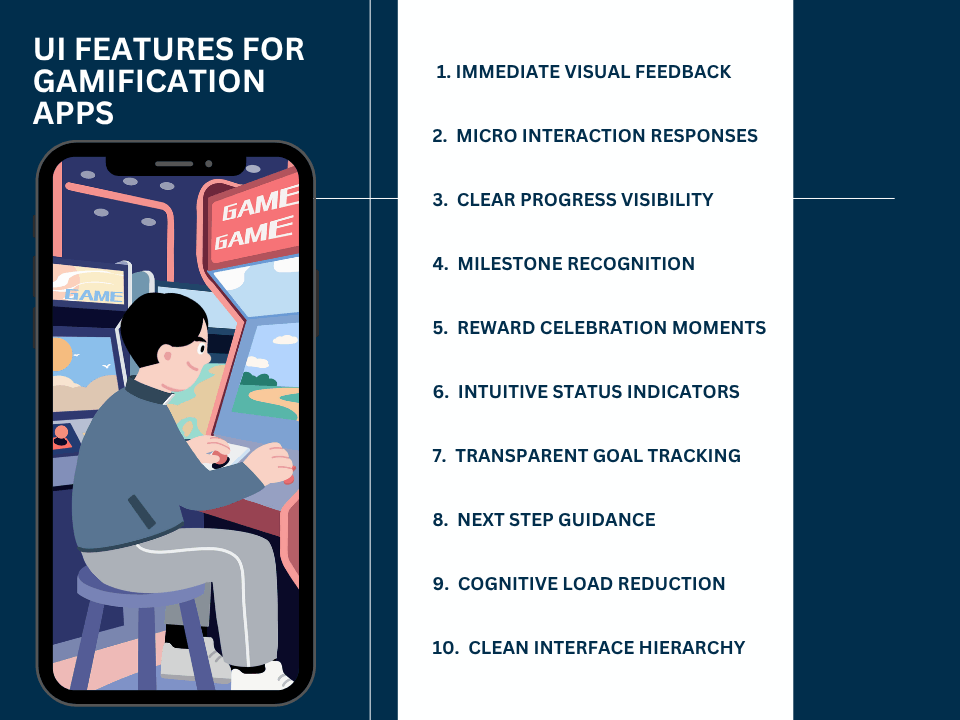
A well-designed gamification app UI plays a critical role in shaping user behavior and reinforcing engagement. The focus here is not only on how an app looks but rather on how it responds to user actions in a way that feels intuitive, motivating, and rewarding.
Every interaction should provide immediate visual feedback, whether through subtle animations, micro interactions, or progress indicators. These feedback loops signal to users that their actions matter, creating a sense of responsiveness that encourages continued use. When users tap a button, complete a task, or reach a milestone, the interface should acknowledge it instantly, turning even small actions into satisfying moments.
For example, consider a user on a fitness journey who finally reaches a personal milestone after weeks or even months of consistent effort. If the app offers no acknowledgment (no visual feedback, no sense of celebration), the achievement can feel underwhelming and easily overlooked. In reality, that moment represents significant progress, and without recognition, the app misses a critical opportunity to reinforce the behavior that led to it.
Clarity is equally important. Users should always understand where they are, what they’ve achieved, and what comes next. Progress bars, status indicators, and clearly defined rewards help guide behavior without requiring extra effort or thought. When users can easily see their advancement, they are more likely to stay engaged and work toward the next goal.
At the same time, simplicity must not be overlooked. Overloading the interface with too many elements can lead to cognitive fatigue, reducing the effectiveness of gamification entirely. A clean, focused design ensures that key actions and rewards stand out, making the experience feel seamless rather than overwhelming.
Ultimately, the goal of a strong gamification app UI is to make every interaction feel instantly rewarding, reinforcing positive behaviors and encouraging users to return.
4 Real-World App Gamification Examples That Work
The most effective way to understand app gamification is to look at how leading platforms apply it in practice. These app gamification examples show carefully designed systems rooted in behavioral psychology, each aligned with a specific user action and business goal.
1. Duolingo
Duolingo is a standout example of how emotional triggers and consistency can drive engagement.
Its streak system encourages daily usage by tapping into loss aversion, where users are motivated to avoid breaking their streak. Combined with celebratory animations and reminders, the app creates a sense of accomplishment and urgency.
This approach transforms learning into a habit, ensuring long-term retention rather than sporadic use.
2. Nike Training Club
Nike Training Club uses guided progression to keep users engaged over time. Instead of overwhelming users with options, it structures workouts into programs that evolve based on performance and commitment. This creates a clear path forward, reinforcing a sense of growth and mastery.
By aligning workouts with user goals, the app ensures that each interaction feels purposeful, which strengthens both motivation and consistency.
3. Starbucks
Starbucks integrates gamification directly into its purchasing experience through a tiered rewards system.
Users earn stars for each transaction, which can be redeemed for tangible benefits. The brilliance lies in how spending is seamlessly tied to progression. Users are incentivized to return more frequently to reach the next reward level. This creates a powerful loop where business goals and user behavior are perfectly aligned.
4. LinkedIn
LinkedIn applies gamification subtly through profile completion prompts and progress indicators. By showing users how “complete” their profile is, it taps into the psychological need for closure and achievement. This encourages users to add more information, which not only improves their experience, but also enhances the platform’s overall value.
The result is higher engagement driven by a simple yet effective behavioral cue.
Measuring the Success of Gamification
Measuring the success of gamification is essential, because without clear data, it’s impossible to know whether your system is actually influencing behavior or simply adding surface-level interaction. Effective gamification should always be tied back to measurable outcomes that reflect real user engagement and business impact.
To evaluate performance, it’s important to track both behavioral and business-driven metrics that show whether users are not only interacting with the app, but also returning and progressing over time.
Key metrics include the following.
- Retention rate: Measures how many users continue using the app over time. Strong gamification should directly improve long-term retention, not just initial sign-ups.
- Daily active users (DAU): Indicates how often users engage with the app. Increasing DAU suggests that gamified systems are successfully driving habitual use.
- Session duration: Shows how long users stay engaged in each session, helping identify whether gamification is creating meaningful interaction or superficial clicks.
- Conversion rates: Tracks how effectively users move from engagement to desired actions, such as purchases, upgrades, or completed tasks.
In addition to tracking metrics, A/B testing of gamified features is critical. By comparing different versions of rewards, challenges, or progression systems, you can identify what truly motivates users versus what simply looks engaging.
Finally, iteration based on real data ensures your gamification strategy evolves with user behavior, rather than relying on assumptions made at launch.
Building a Gamified App: Why the Right Partner Matters
Building a successful gamified app is not just a design or development exercise; it requires a careful blend of strategy, psychology, and technical execution working together from the very beginning. Many gamification initiatives fail not because the idea is weak, but because the implementation lacks depth in how user behavior is understood and shaped over time.
Effective gamification requires more than adding points or badges. It demands a structured approach that integrates UX strategy, behavioral design, and scalable development architecture. UX strategy ensures that every interaction feels intuitive and rewarding, while behavioral design focuses on understanding what truly motivates users and how those motivations shift over time. Without this foundation, gamified elements often become superficial features that fail to sustain engagement.
On the technical side, scalability is equally important. As user engagement grows, the system must support dynamic progression models, real-time feedback loops, and personalized experiences without compromising performance. This is where thoughtful development becomes essential, building systems that can evolve alongside user behavior and business needs.
This is also why choosing the right partner matters. Working with a specialist gamification app development company ensures that all three layers (strategy, design, and engineering) are aligned from the outset, rather than bolted on as an afterthought.
At AppIt, gamification is not treated as a feature set but as a core product strategy. Every solution is custom-built to match the specific goals of the business, rather than relying on pre-built templates that limit flexibility and long-term impact.
If you’re looking to build a system that genuinely drives engagement and measurable results, the right approach is to partner with a team that understands both the psychology behind user behavior and the technical architecture required to support it.
Partner with AppIt and turn ideas into high-performing apps.