Building a gamification app is not just about adding points or badges. It is about creating experiences that inspire action, loyalty, and engagement. Businesses that get it right do more than simply capture attention; they influence behavior, drive results, and build lasting connections with users.
From motivating employees to rewarding customers, gamification turns everyday interactions into meaningful experiences.
This article breaks down what gamification is, how it works, and how to design a gamification app that delivers real impact for your business.
What Is Gamification in Business?
Gamification, at its core, refers to the application of game-like elements to non-game contexts in order to influence behavior and increase engagement.
In a business setting, this means using structured mechanics to guide how users, customers, or employees interact with a product, service, or process. It is the strategic use of tools like points, badges, leaderboards, progress tracking, and rewards to encourage specific actions and create more engaging experiences.
These elements provide feedback, recognize achievement, and motivate continued participation. Importantly, gamification is not about building full-scale games within your business environment. Instead, it’s about designing systems that tap into natural human drivers such as achievement, competition, and progression.
When implemented correctly, gamification becomes a powerful way to shape behavior, improve engagement, and create more meaningful interactions between users and your digital platforms.
How Gamification Works: The Mechanics Behind Engagement
Gamification works by combining structured design with behavioral psychology to guide how users interact with an app over time. When applied effectively, these mechanics are key to driving mobile app user engagement through gamification by turning simple actions into rewarding experiences.
- Feedback loops: Immediate feedback, such as points or confirmations, reinforces actions, while delayed rewards, like unlocking levels, build anticipation and long-term engagement.
- Progress and achievement: Visible progress bars, milestones, and levels give users a sense of advancement, encouraging them to continue interacting to reach the next goal.
- Competition vs collaboration: Leaderboards tap into competitive instincts, while team challenges encourage collaboration. Both motivate users in different but equally effective ways.
- Habit formation: Repeated actions, supported by consistent rewards, help users form habits, making engagement feel natural rather than forced.
Types of Gamification Apps for Business
Gamification can be applied across different areas of a business, depending on the behaviors you want to influence and the outcomes you want to achieve. Understanding the different types of gamification apps for business helps clarify where and how this approach can deliver the most value.
Loyalty and Customer Engagement
A loyalty gamification app is designed to encourage repeat interaction by rewarding customers for ongoing engagement. This can include points-based rewards programs, tiered membership levels, or interactive challenges that unlock exclusive benefits.
These systems go beyond traditional loyalty programs by making the experience more dynamic and engaging.
The business impact is significant:
- customers are more likely to return,
- spend more frequently, and
- build a stronger emotional connection with the brand.
Sales Enablement
A sales gamification app, or sales gamification software, focuses on motivating sales teams by making performance more visible and rewarding. Features such as leaderboards, milestone incentives, and real-time performance tracking create a sense of competition and achievement.
These tools help shift focus from just hitting targets to actively engaging in the process of selling. As a result, businesses often see increased sales activity, improved motivation, and more consistent performance across teams.
Employee Engagement and Productivity
Gamification apps for employee engagement are used to improve how employees interact with their work and internal systems. A gamification productivity app might include onboarding journeys, task completion tracking, or training modules that reward progress and participation.
These tools make everyday tasks more engaging and provide employees with clear goals and feedback. The impact includes higher productivity, improved morale, and better long-term retention, as employees feel more connected to their work and achievements.
Benefits of Gamification Apps for Business
Gamification apps for business deliver measurable value by aligning user behavior with business objectives. When designed correctly, they do more than engage, they create lasting interactions that drive growth, loyalty, and performance.
- Higher engagement: Gamification encourages users to interact more frequently by making experiences interactive and rewarding. This leads to improved retention as users are more likely to return and continue engaging over time.
- Customer loyalty: By rewarding consistent interaction, businesses can strengthen relationships with their customers. This increases customer lifetime value as users develop habits around your product or service and feel incentivized to stay.
- Employee performance: Gamified systems can motivate employees by providing clear goals, recognition, and a sense of achievement. This often results in improved productivity, higher satisfaction, and more consistent performance.
- Actionable insights: Gamification systems generate valuable data on user behavior, preferences, and engagement patterns. These insights allow businesses to refine strategies and make more informed decisions.
- Brand differentiation: Interactive and engaging experiences help brands stand out in competitive markets. Gamification creates memorable interactions that strengthen brand perception and encourage deeper connection.
Why Most Gamification Apps Fail
Many gamification apps fall short because they rely too heavily on surface-level mechanics without a clear strategy behind them. Simply adding points, badges, or leaderboards does not guarantee meaningful engagement, especially when these elements are not tied to real user motivations.
A common issue is a lack of deep user understanding, where businesses fail to consider what actually drives their audience to act. In other cases, gamification is poorly aligned with business goals, resulting in activity that looks positive on the surface but delivers little real value. This often leads to short-term spikes in engagement that quickly fade once the novelty wears off.
Ultimately, the problem is not gamification itself, but how it is implemented. Effective gamification must be intentionally designed as part of the overall experience, rather than added on as an afterthought.
Designing Gamification Around Real Users
Effective gamification starts with understanding the people who will use it. Different users are motivated by different factors, whether intrinsic drivers like personal achievement and mastery, or extrinsic rewards such as recognition and incentives. This is why personalization plays a critical role in successful gamification software, allowing experiences to adapt to individual behaviors and preferences.
Rather than focusing only on features, businesses need to design systems that reflect how users actually think and act. A human-centered approach considers context, intent, and motivation at every stage of the experience. This is especially important when driving mobile app user engagement through gamification, as relevance determines whether users continue to engage or drop off.
Ultimately, people respond to experiences that feel meaningful and aligned with their goals, not ones that feel forced or generic.
How to Build a Gamification App for Your Business
Building a gamification app for your business requires more than adding game elements; it involves designing a structured experience that aligns user behavior with business goals. A thoughtful, step-by-step approach ensures that the final product is both engaging and effective.
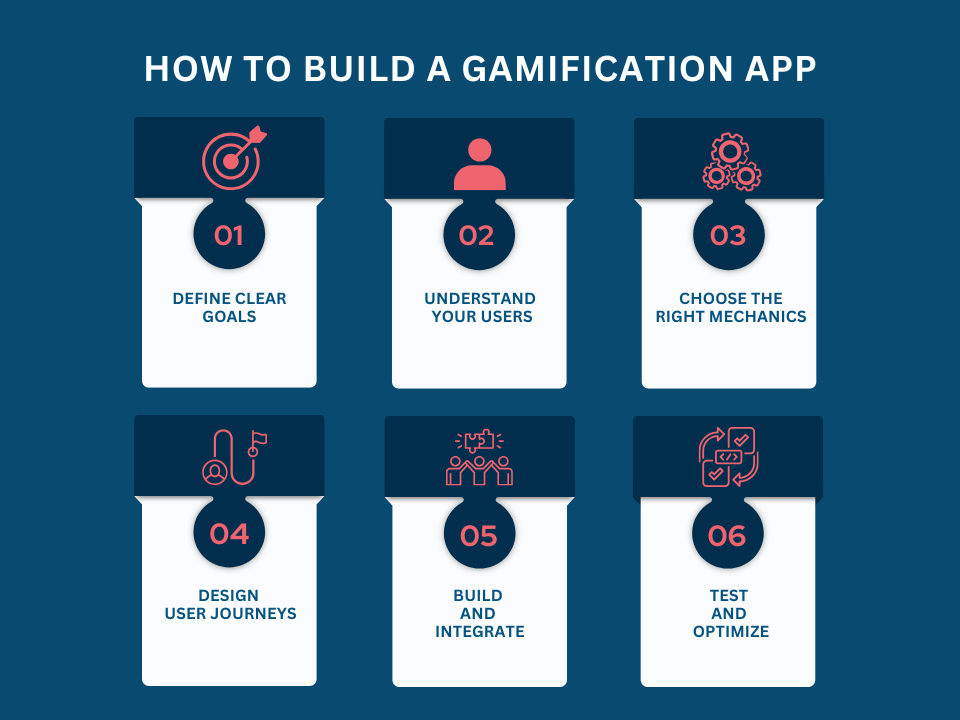
- Define clear goals: Start by identifying what you want to achieve from both a business and user perspective. Whether it’s increasing engagement, improving retention, or boosting performance, clear goals guide every decision that follows.
- Understand your users: Identify your target audience and the specific behaviors you want to influence. Understanding user motivations ensures the gamification strategy is relevant and impactful.
- Choose the right mechanics: Select gamification elements that support your goals, such as rewards, progress tracking, or challenges. The key is to use mechanics that enhance the experience, not overwhelm it.
- Design user journeys: Map out how users will interact with the app over time. Well-designed engagement loops encourage repeat actions and build long-term habits.
- Build and integrate: Develop the app with scalability and integration in mind, ensuring it works seamlessly with existing systems and platforms.
- Test and optimize: Continuously measure performance and refine the experience based on real user data to ensure long-term success.
Off-the-Shelf Gamification Software vs Custom Development
Choosing between off-the-shelf gamification software and a custom-built solution starts with understanding your business goals, user needs, and the level of flexibility required.
Off-the-shelf tools can be a good fit for simple use cases, quick deployment, or standardized features, especially when timelines or budgets are tight. However, these generic solutions often come with limitations, including restricted flexibility, limited personalization, and challenges integrating with existing systems or scaling as your business grows.
Custom gamification apps, on the other hand, are built around your users, ensuring experiences that are relevant, engaging, and tailored to your specific objectives. They integrate seamlessly with your existing platforms and are designed to evolve with your business, supporting long-term engagement and continuous improvement.
At AppIt, we focus on creating custom solutions that align with both user behavior and business outcomes, delivering gamification experiences that are meaningful, sustainable, and impactful.
Measuring the Success of a Gamification App
Measuring success is essential to understanding whether your gamification strategy is delivering real value. Rather than relying on surface-level metrics, businesses should focus on indicators that reflect meaningful engagement and behavior change.
- Engagement rates: Track how often users interact with the app and how deeply they engage with its features.
- Retention: Measure how many users return over time, indicating sustained interest and habit formation.
- Conversion rates: Assess whether gamification is driving desired actions, such as purchases, sign-ups, or task completion.
- Productivity metrics: For internal tools, evaluate improvements in efficiency, output, and overall performance.
Gamification should never be treated as a one-time implementation. Continuous monitoring and optimization are key to refining the experience and ensuring it remains relevant. Over time, gamification evolves into a dynamic system that adapts to user behavior and business needs.
Gamification as a Strategic Growth Tool
Gamification is most effective when approached as a long-term strategy rather than simply a set of features. At its core, it is about shaping behavior and creating meaningful interactions that drive consistent engagement.
Successful gamification focuses on influencing user actions, not just adding mechanics, ensuring that every element serves a purpose. When businesses prioritize experiences that are relevant and personalized, they create stronger, more lasting connections with their users.
Well-designed gamification also supports sustainable growth, fostering ongoing engagement, loyalty, and measurable performance improvements. By taking a user-first approach, companies can transform how people interact with their digital platforms.
At AppIt, we develop custom apps for business with this principle at the center; designing experiences that are engaging, purposeful, and truly aligned with the people using them.
Contact us at AppIt if you’re ready to explore how gamification can drive growth and meaningful interactions, our team is here to help.