Custom web and mobile apps are becoming the central hub for how customers discover, evaluate, and purchase products. From personalized shopping experiences to seamless checkout and real-time promotions, apps are transforming how retail businesses operate and engage with their audience.
This article explores the key benefits of custom retail app development, including how apps unify sales and marketing, enhance customer engagement, leverage location-based technologies, and support operational efficiency through enterprise and web-based systems.
Whether you’re looking to improve the in-store experience, expand e-commerce capabilities, or gain actionable insights from customer data, understanding the potential of retail apps is essential for driving growth and staying competitive.
The Rise of the Mobile Retail Industry
Over the past decade, the mobile retail industry has experienced rapid growth as smartphones have become the primary way consumers interact with brands and make purchasing decisions.
What began as simple mobile browsing has evolved into a fully integrated shopping ecosystem, where customers can discover products, compare prices, read reviews, and complete purchases directly from their devices. Today, mobile commerce (often referred to as m-commerce) accounts for a significant share of global retail activity, with mobile devices already being responsible for about 57% of global e-commerce sales back in 2024 and continuing to rise.
Consumer behavior has shifted alongside this growth. Shoppers increasingly expect to browse and buy whenever and wherever it’s convenient, whether they’re commuting, relaxing at home, or standing inside a store comparing products. In fact, 76% of US adults report making purchases directly from their smartphones, while billions of hours are spent each year using retail and shopping apps.
These trends have pushed retailers toward mobile-first digital strategies, where seamless performance, intuitive interfaces, and fast checkout experiences are no longer optional. As mobile becomes the default shopping channel, retail businesses are increasingly turning to custom mobile and web applications to meet evolving customer expectations.
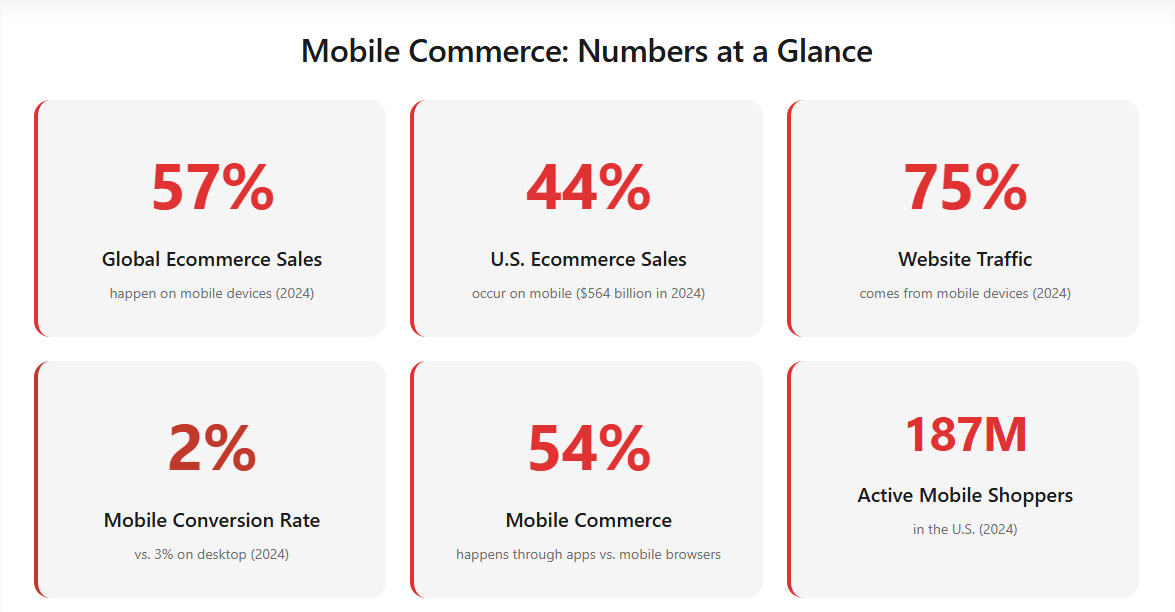
Source: https://redstagfulfillment.com/what-percentage-of-ecommerce-sales-on-mobile-devices/
What Are Custom Retail Apps and Why Do Retailers Invest in Them?
Custom retail app development refers to designing and building digital applications specifically tailored to a retailer’s business model, operations, and customer experience goals. Rather than adapting their processes to fit generic software, retailers can create applications that align directly with how their stores operate, how customers shop, and how teams manage inventory, orders, and data. As retail businesses become more digitally driven, this level of customization allows companies to build technology that supports both their customer-facing experiences and their internal workflows.
To understand the value of custom development, it helps to distinguish between the main types of retail software solutions:
- Off-the-shelf retail software: Pre-built platforms designed for broad use across many businesses. These tools are quick to implement but often lack flexibility and may include features retailers don’t need while missing others they do.
- Custom web apps: Browser-based platforms built specifically for a retailer’s operations, such as management dashboards, vendor portals, or centralized inventory systems.
- Custom mobile apps: Smartphone applications designed for customers or staff, supporting features like mobile shopping, loyalty programs, in-store assistance, and personalized promotions.
Retailers often invest in custom solutions because they allow for:
- unique customer journeys tailored to their brand and audience
- operational workflows that match how their teams actually work
- seamless integration with existing systems like POS platforms, inventory tools, and CRM software.
Ultimately, customization gives retailers the flexibility to build technology that grows alongside their business.
Connecting Marketing, Sales, and Customer Engagement
One of the most powerful advantages of retail mobile apps is their ability to bring marketing, sales, and customer engagement together in a single digital environment. Traditionally, these functions operated separately, where marketing focused on attracting attention and sales handled transactions.
Mobile apps bridge this gap by creating a unified platform where retailers can promote products, interact with customers, and facilitate purchases at every stage of the buying journey.
Within a retail app, marketing campaigns and promotions can be delivered directly to users through push notifications, ensuring customers are instantly aware of new products, limited-time offers, or seasonal sales. Retailers can also use customer data to deliver personalized offers that align with browsing behavior and past purchases, making promotions more relevant and effective.
Features such as in-app promotions, loyalty programs, and intuitive product discovery tools further encourage customers to explore and engage with a brand’s offerings. Instead of moving between multiple channels, shoppers can discover products, learn more about them, and complete their purchase within the same environment.
This seamless experience creates a continuous customer journey while strengthening long-term customer relationships.
Transforming the Shopping Experience with Social Proof and Customer Feedback
Modern shoppers rarely make purchasing decisions without first looking for feedback from other customers. Retail mobile apps make it easier for retailers to integrate social proof directly into the shopping experience by showcasing product reviews, ratings, and recommendations alongside product listings. Instead of searching across multiple websites for opinions, customers can quickly access feedback from other buyers within the same platform where they are browsing and purchasing.
Many retail apps also support user-generated content, allowing customers to upload photos, share experiences, and provide detailed reviews of products they’ve purchased. This type of authentic feedback gives prospective buyers a clearer sense of how a product performs in real-life situations. In addition, social sharing features allow users to send products to friends or share them on social platforms, further expanding the influence of peer recommendations.
Because reviews and ratings are displayed directly during product discovery and checkout, customer feedback becomes a visible and influential part of the buying journey. By highlighting real customer experiences, retail apps help build trust, reduce uncertainty, and increase overall purchase confidence.
Real-Time Customer Engagement Through Location-Based Technologies
As mobile technology continues to evolve, retailers are finding new ways to engage with customers based on their real-world location. Retail mobile apps can integrate location-based technologies that allow businesses to interact with shoppers at the right place and the right time, creating more relevant and timely experiences both inside and outside the store.
Several technologies make this possible, including the following.
- Beacons: Small wireless devices placed in stores that communicate with nearby smartphones via Bluetooth. When a customer with the retailer’s app walks past or enters a specific area, the beacon can trigger messages, promotions, or product information.
- Geofencing: A virtual boundary set around a physical location. When customers enter or leave this designated area, the app can automatically trigger notifications or promotional messages.
- Location-aware push notifications: Notifications that are triggered based on a user’s real-time location, allowing retailers to deliver highly relevant updates.
These tools enable valuable retail experiences such as:
- in-store promotions delivered while customers are browsing,
- personalized offers triggered when shoppers enter a store, and
- smart store navigation that helps customers find specific products.
By combining these technologies, retailers can create hyper-local, real-time engagement that enhances the in-store shopping experience.
Progressive Web Apps in Retail
If there is hesitancy about building a retail mobile app then a progressive web app might be the answer.
Progressive web apps (PWAs) are modern web technology that combines the accessibility of a website with the functionality of a mobile app. Instead of requiring users to download an application from an app store, PWAs run directly in a web browser while still delivering many of the same features and performance benefits associated with native mobile apps. For retailers, this creates an opportunity to provide a streamlined mobile experience while removing some of the friction that can come with app installations.
One of the key advantages of progressive web apps in retail is their ability to deliver an app-like experience within a browser environment. PWAs are designed to load quickly, adapt to different screen sizes, and function smoothly across a wide range of devices. They can also support offline functionality, allowing customers to continue browsing products even when their Internet connection is limited. Faster load times and simplified development processes can also make PWAs a more cost-effective option compared to building separate native applications for multiple platforms.
By combining the strengths of web and mobile technology, PWAs offer retailers another powerful strategy for improving digital shopping experiences.
Enterprise Applications for Retail
While many retail apps focus on improving the customer experience, enterprise applications for retail play an equally important role behind the scenes.
These applications are designed to support the operational side of retail businesses, helping teams manage complex processes, coordinate resources, and maintain visibility across multiple departments. By centralizing key functions within a single system, enterprise retail apps allow businesses to operate more efficiently while reducing manual tasks and operational errors.
Enterprise applications can support several critical areas of retail operations.
- Inventory management: Real-time tracking of stock levels across stores and warehouses, helping retailers avoid overstocking or running out of popular items.
- Order processing: Streamlining how orders are received, processed, and fulfilled across online and in-store channels.
- Supply chain tracking: Monitoring the movement of goods from suppliers to distribution centers and retail locations.
- Employee productivity: Providing staff with tools to manage tasks, schedules, and store operations more efficiently.
- Store management systems: Supporting daily store activities such as reporting, performance tracking, and operational coordination.
How Do Custom Web Apps Benefit Retail Businesses?
While mobile apps often focus on customer engagement, custom web apps provide powerful tools that support the broader digital infrastructure of a retail business. These browser-based systems allow retailers to manage data, operations, and communication across multiple locations and departments through centralized platforms accessible from anywhere.
Custom web applications can take many forms depending on the needs of the business, including:
- Vendor portals: Platforms where suppliers can update product information, manage orders, and coordinate deliveries.
- Retail analytics dashboards: Interactive reporting tools that allow retailers to monitor sales performance, customer trends, and operational metrics in real time.
- Customer data platforms: Systems that consolidate customer information from multiple channels to support personalization and targeted marketing.
- Omnichannel management systems: Tools that help retailers coordinate inventory, orders, and customer interactions across online stores, physical locations, and mobile platforms.
By implementing these systems, retailers gain the ability to support data-driven decision making, manage operations across multiple store locations, and maintain centralized reporting that keeps leadership teams informed and responsive.
Key Features That Make a Successful Retail Mobile App
A successful retail mobile app creates a convenient, engaging, and personalized shopping experience. The following features help retailers deliver value to customers while improving conversion and retention.
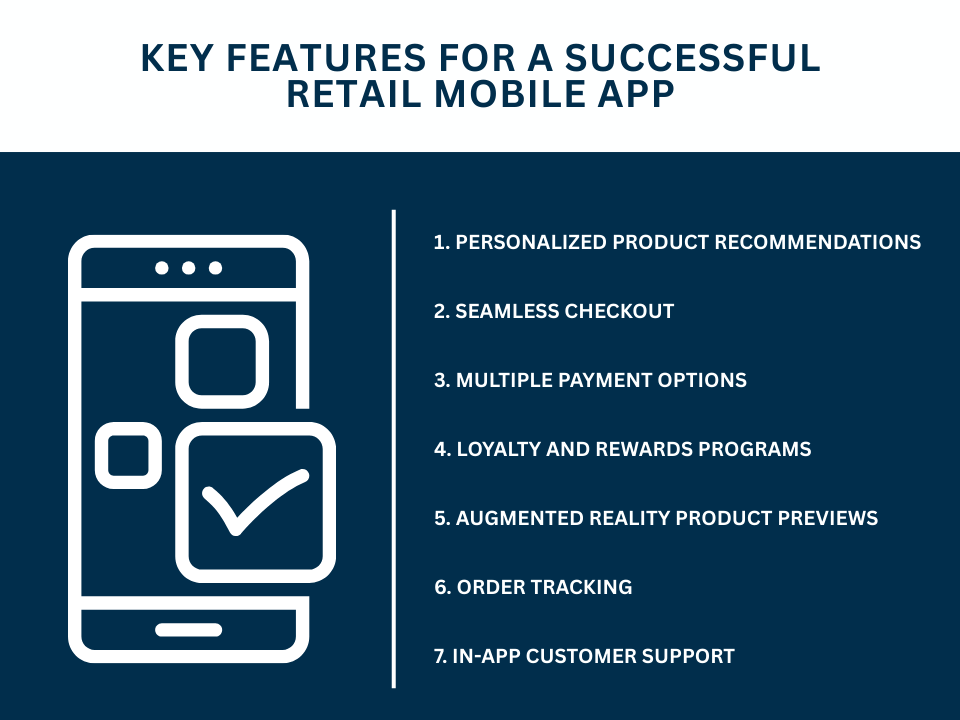
1. Personalized Product Recommendations
Using customer data such as browsing behavior, purchase history, and preferences, apps can suggest products that are most relevant to each user. This helps shoppers discover items faster while increasing the likelihood of additional purchases.
2. Seamless Checkout
A streamlined checkout process reduces friction and cart abandonment. Features like saved shipping information, auto-filled forms, and minimal steps help customers complete purchases quickly.
3. Multiple Payment Options
Supporting various payment methods (including credit cards, digital wallets, and mobile payment platforms) gives customers flexibility and improves the overall purchasing experience.
4. Loyalty and Rewards Programs
Built-in loyalty systems encourage repeat purchases by allowing customers to earn points, access exclusive deals, or receive personalized discounts.
5. Augmented Reality Product Previews
Augmented reality (AR) technology allows shoppers to visualize products in their environment before purchasing, which is especially valuable for items like furniture or décor.
6. Order Tracking
Real-time order tracking keeps customers informed about their purchases from confirmation to delivery.
7. In-App Customer Support
Chat features or support portals allow customers to quickly resolve issues, ask questions, and receive assistance without leaving the app.
When Should a Retail Business Invest in Custom Retail App Development?
Not every retailer needs a custom app immediately, but there are several clear indicators that will show when investing in custom retail app development can deliver meaningful value. Recognizing these signs helps businesses determine when the time is right to build a dedicated digital solution.
- Increased e-commerce demand: If a large percentage of sales are coming from mobile users, a custom app can provide a faster, more optimized shopping experience than a standard website.
- Need for omnichannel retail: Retailers operating both online and in physical stores may need an app to connect these experiences, enabling services like in-store pickup, mobile promotions, and synchronized inventory.
- Scaled operations: As a retail business expands to multiple locations or markets, custom apps can help streamline communication, management, and customer interactions.
- Customer engagement challenges: If retailers struggle to keep customers engaged with promotions, loyalty programs, or product updates, a mobile app can provide direct communication through notifications and personalized offers.
- Desire for deeper analytics: Custom apps provide valuable insights into customer behavior, allowing retailers to track engagement, preferences, and purchasing trends more effectively.
How Retailers Can Successfully Implement Custom Apps
Developing a successful retail app requires careful planning and a clear understanding of both business objectives and customer needs. The process typically begins with defining an app strategy that outlines the primary goals of the platform, whether that involves improving customer engagement, streamlining operations, or expanding digital sales channels. From there, retailers must establish clear user experience goals, ensuring the app is intuitive, responsive, and easy for customers or employees to navigate.
Integration is another critical factor. Retail apps should connect seamlessly with existing systems such as point-of-sale platforms, inventory management tools, and customer relationship management software. This ensures that data flows smoothly across all parts of the business.
Once development begins, thorough testing and iteration are essential to identify performance issues, refine features, and improve usability before a full launch. Retailers should also plan for long-term scalability, allowing the application to grow alongside the business as new features, stores, or digital services are added over time.
Building the Right Digital Tools for Modern Retail
The retail landscape has become increasingly digital, with technology playing a central role in how businesses interact with customers and manage their operations. Mobile apps, custom web applications, and enterprise systems are no longer optional add-ons; they are foundational tools that help retailers remain competitive in a fast-changing marketplace.
From enhancing customer engagement to streamlining internal processes, these solutions allow businesses to connect every part of their retail ecosystem.
However, not all retail businesses operate in the same way. Factors such as product types, customer demographics, store locations, and operational structures can vary widely from one retailer to another. This is why tailored digital solutions are often more effective than generic platforms. Custom-built applications allow retailers to design experiences and systems that align directly with their goals, workflows, and long-term growth strategies.
Working with an experienced development partner can help ensure that these applications are scalable, secure, and built with both users and business objectives in mind. At AppIt, we specialize in designing and developing custom mobile and web applications that support the evolving needs of modern retail businesses.
If you're exploring new ways to strengthen your digital presence, our team can help you build solutions that support sustainable growth and long-term success.
Contact us at AppIt today.