


Every day, new app ideas enter the market, but only a small percentage ever turn into profitable products. The difference isn’t just creativity or technical execution; it’s understanding what makes an idea commercially viable from the start.
In app development, success comes from identifying real opportunities, aligning with user demand, and building with a clear monetization strategy in mind.
This article explores the types of app ideas that consistently generate revenue, what separates average concepts from high-performing ones, and how to position your app for long-term success.
Whether you’re an entrepreneur, startup founder, or business looking to expand digitally, these insights will help you move beyond inspiration and toward building an app that truly delivers results.
What Differentiates Good App Ideas from Great App Ideas?
Not all app ideas are created equal. What separates a good idea from a truly profitable one comes down to strategic depth.
Great apps are rooted in clear market demand, not just ‘nice-to-have’ concepts that struggle to gain traction. They solve real, recurring problems that users face consistently, which naturally drives engagement and long-term retention.
Beyond the initial idea, scalability plays a critical role; the best apps are designed to grow with their user base without losing performance or value.
Another defining factor is monetization. Successful apps are built with revenue in mind from the start, rather than trying to layer it in later.
Finally, timing matters more than many realize. Even strong web or mobile app ideas can fail if they enter the market too early or too late, while those aligned with current trends and user behavior are far more likely to succeed.
Service and Loyalty Apps vs Revenue-Driven Apps
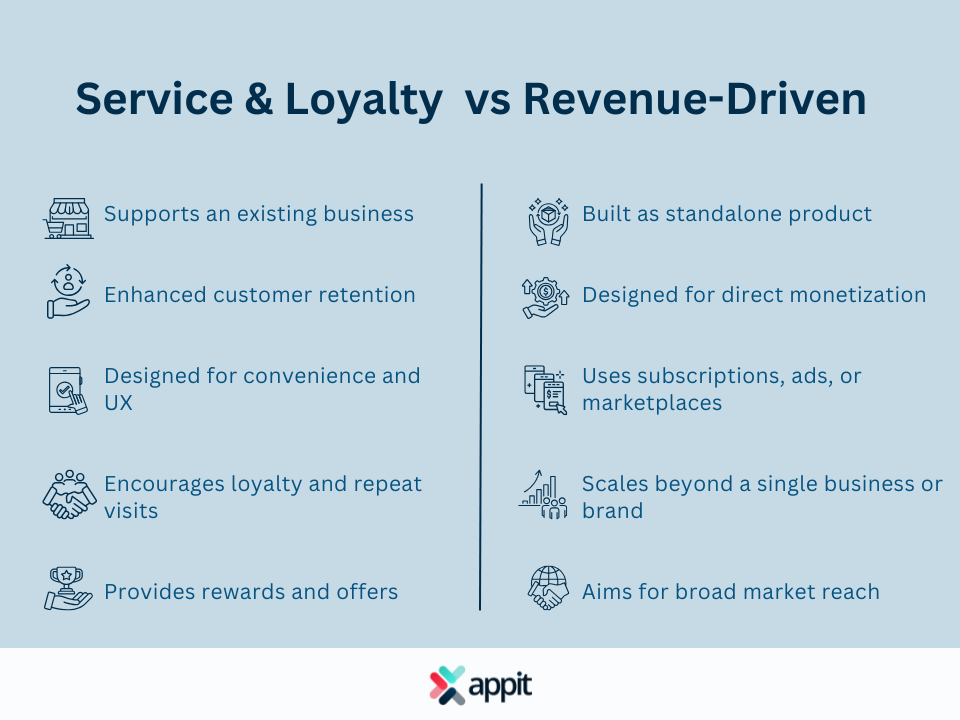
Not all apps are designed to generate revenue in the same way. Some support an existing business by enhancing customer relationships, while others are built as standalone products with direct monetization at their core.
Service and Loyalty Apps
Service and loyalty apps are developed to strengthen an existing business rather than function as independent revenue streams. These apps prioritize customer retention, convenience, and overall experience by giving users easier access to products, services, or rewards.
Think of branded retail or restaurant apps that allow customers to order ahead, earn loyalty points, or receive exclusive offers. While they may not generate significant direct income, their value lies in increasing customer lifetime value, encouraging repeat purchases, and building brand loyalty over time.
Revenue-Driven Apps
Revenue-driven apps, on the other hand, are built as standalone digital products with clear monetization strategies from day one. These apps generate income directly through subscriptions, in-app purchases, advertising, or marketplace commissions.
Unlike service apps, they are designed to scale beyond a single business and reach a broader audience. Their success depends on strong user acquisition, engagement, and a well-executed monetization model, making them powerful, scalable sources of revenue when done right.
Tried and Tested App Ideas to Make Money
While innovation is important, many of the most profitable apps today follow proven models. Understanding why these categories succeed can help you shape an idea that is both practical and scalable.
Productivity Apps
Productivity apps consistently perform well because they become part of a user’s daily routine. Whether it’s managing tasks, organizing workflows, or improving focus, these apps solve ongoing problems that users are willing to pay to fix. Their success lies in delivering clear, tangible value, which can include saving time or reducing mental load.
Because of their high daily usage, subscription models work particularly well, offering premium features, integrations, or enhanced functionality. Apps like Notion and Todoist have built strong user bases by continuously evolving their features while maintaining simplicity and usability.
Entertainment Apps
Entertainment apps thrive on scale. They attract massive audiences by offering content that users can consume endlessly, from videos to streaming media. Their success is driven by engagement, focusing on keeping users on the platform for as long as possible.
This opens the door to multiple monetization strategies, including advertising, subscriptions, and in-app purchases. The key is delivering content that feels personalized and constantly refreshed.
Platforms like Netflix and TikTok dominate this space by combining data-driven recommendations with highly engaging user experiences that keep audiences coming back.
Educational Apps
Educational apps tap into a universal and ongoing need: learning.
Whether it’s acquiring new skills, advancing careers, or exploring personal interests, users are increasingly turning to mobile platforms for flexible learning opportunities.
These apps benefit from global scalability, as content can often be distributed across regions with minimal changes. Monetization typically follows a freemium model, where basic content is free but advanced features or courses require a subscription.
Successful platforms like Duolingo and Coursera demonstrate how gamification, structured learning paths, and accessible content can drive both engagement and revenue.
Health and Wellness Apps
Health and wellness apps have seen rapid growth as users become more proactive about their physical and mental well-being. These apps often focus on habit formation (tracking calories, guiding workouts, or supporting mindfulness) which encourages consistent, long-term engagement.
Because users see personal value in improving their health, they are more willing to pay for premium features, personalized plans, or coaching add-ons. Therefore, subscription models work particularly well in this space.
Apps like MyFitnessPal and Headspace succeed by combining data tracking with user-friendly design and ongoing motivation.
Service Marketplace Apps
Service marketplace apps are powerful because they connect two sides of a market; those offering services and those seeking them.
By facilitating this interaction, they create value at scale and often become essential platforms within their industries. Their monetization model is typically commission-based, earning a percentage from each transaction. The more users they attract, the stronger the network becomes.
Apps like Uber and TaskRabbit have demonstrated how effectively matching supply and demand can lead to significant revenue and market dominance.
Connection and Community Apps
Connection and community apps leverage one of the most powerful forces in technology: network effects.
As more users join, the platform becomes increasingly valuable, often leading to exponential growth. These apps focus on bringing people together, whether for dating, shared interests, or professional collaboration.
Monetization typically comes from advertising or premium features that enhance visibility or interaction. Platforms like Tinder and Discord have built highly engaged user bases by creating spaces where people can connect, communicate, and form meaningful relationships.
Emerging App Opportunities to Watch
As technology and user behavior continue to evolve, new app opportunities are emerging with strong revenue potential. Tapping into these trends early can give your app a significant competitive advantage.
- AI-Powered Apps: Apps powered by artificial intelligence are rapidly transforming how users interact with technology. From personal assistants to automation tools, these apps streamline tasks, enhance productivity, and deliver highly personalized experiences. Their ability to adapt and improve over time makes them especially valuable and scalable.
- Niche Communities: Users are moving away from broad social platforms in favor of smaller, more focused communities. Apps that cater to specific interests, industries, or identities can build highly engaged user bases. These micro-communities often drive stronger retention and more meaningful interaction.
- Fintech Solutions: Financial wellness apps are gaining traction as users seek better control over their money. Budgeting tools, investment platforms, and financial education apps offer ongoing value, making them ideal for subscription-based or service-driven monetization models.
- Remote Collaboration: With remote and hybrid work now becoming a standard, apps that improve communication, project management, and team collaboration continue to grow in demand. These tools are often deeply integrated into daily workflows, increasing their long-term value.
- On-Demand Services: Convenience remains a major driver of app success. On-demand and hyperlocal service apps connect users with nearby providers quickly and efficiently, creating scalable platforms that thrive on real-time demand.
Can You Patent an Idea for an App?
This is one of the most common questions entrepreneurs ask when exploring app development but the answer is often misunderstood.
The short answer is no: you cannot patent a raw app idea on its own. An idea, without specific implementation, isn’t considered intellectual property in the eyes of patent law.
What you can protect are the unique and technical elements behind how your app works.
- Unique processes: Specific methods your app uses to perform a function
- Technical functionality: How features are built and executed
- Algorithms: Proprietary logic or calculations powering the app
- Data handling: Innovative ways of processing or managing data
- User interface (UI): In some cases, distinctive and novel design elements
It’s also important to note that while the idea itself may not be patentable, your branding can be protected. This includes your app’s name, logo, and slogans through trademarks.
A common misconception is that having a great idea alone guarantees protection. In reality, execution, technical uniqueness, and speed to market are what truly create a competitive edge.
How to Patent an App Idea
If your app includes unique technical elements, securing a patent can help protect your innovation. However, the process requires careful planning and documentation.
- Patent Search: Before filing, conduct a thorough patent search to ensure your app’s functionality is truly unique. This helps you avoid conflicts and strengthens your application.
- Document Everything: Create detailed documentation outlining how your app works. This should include features, workflows, technical processes, and any unique methods that differentiate it from existing solutions.
- Choose the Patent Type: Decide between a provisional patent, which offers temporary protection, or a non-provisional patent, which is the full, formal application reviewed for approval.
- File Application: Submit your application to the US Patent and Trademark Office (USPTO), ensuring all technical descriptions and claims are clearly defined.
- Monitor Progress: After submission, be prepared to respond to examiner questions or requests for clarification to move your application toward approval.
Turning an Idea into a Profitable App
A great idea is only the starting point. Turning it into a profitable app requires a structured, strategic approach.
The first step is validation. Before investing heavily in development, successful founders test their concepts through market research, competitor analysis, and often a minimum viable product (MVP). This ensures there is real demand and helps refine the concept early.
From there, user experience becomes critical. A well-designed UX/UI isn’t just about aesthetics; it directly impacts user retention, engagement, and ultimately revenue. Even the most innovative apps can fail if they are difficult or frustrating to use.
Behind the scenes, scalable architecture is equally important. Your app must be built to handle growth, allowing it to expand seamlessly as user demand increases.
Finally, continuous iteration is what separates average apps from market leaders. Launching is just the beginning; ongoing updates, feature improvements, and user feedback loops drive long-term success. This is where working with an experienced development partner like AppIt becomes invaluable, ensuring your app is not only built well but positioned to grow, adapt, and generate revenue over time.
Choosing AppIt as Your App Development Partner
Building a successful app takes more than just a strong idea; it requires the right combination of strategy and execution. That’s where AppIt stands out.
As custom app development experts, AppIt works closely with clients to transform concepts into high-performing, scalable digital products. Our approach goes beyond development, focusing on user experience, long-term growth, and built-in monetization strategies that drive real results.
Whether you’re refining an early idea or ready to launch, having the right partner can make all the difference. The AppIt team brings the technical expertise and strategic insight needed to guide your app from concept to market success.
If you’re ready to turn your idea into a profitable app, now is the time to take the next step. Reach out to us at AppIt for a consultation or discovery session and start building with confidence.