Telehealth and telemedicine are no longer niche solutions; they are becoming progressively integral to how healthcare is delivered and experienced. From virtual consultations to wearable monitoring, digital tools are reshaping the relationship between patients and providers, enabling faster insights, more personalized care, and greater accessibility.
As these technologies evolve, understanding the trends that are driving adoption, shaping patient expectations, and supporting clinical decision-making is essential for anyone involved in healthcare innovation.
This article explores the key future trends in telehealth and telemedicine, highlighting how digital applications are transforming the delivery, management, and experience of care.
Telehealth vs Telemedicine
Although often used interchangeably, telehealth and telemedicine represent two distinct, yet closely connected, approaches to digital healthcare.
Telehealth refers to the broader digital healthcare ecosystem, encompassing remote patient monitoring, health education, preventive care, wellness tracking, and the collection of long-term health data through connected devices and applications. It focuses on supporting overall health outcomes by enabling continuous engagement beyond traditional clinical settings.
Telemedicine, by contrast, is more narrowly focused on delivering clinical services remotely. This includes virtual consultations, diagnoses, treatment plans, follow-up care, and prescription management conducted by licensed healthcare professionals. Telemedicine replicates the clinical encounter through digital channels, improving access to care while maintaining medical accountability.
When designing modern healthcare applications, understanding the difference matters. Effective digital health solutions rarely focus on one without the other. The most impactful platforms integrate telehealth’s continuous data and preventive insights with telemedicine’s clinical decision-making, creating cohesive, patient-centered healthcare experiences that scale across both web and mobile environments.
7 General Telehealth and Telemedicine Future Trends
As telehealth and telemedicine continue to mature, the most impactful changes are happening at a foundational level. Rather than focusing on specific devices or platforms, these broader trends reflect how digital healthcare is being integrated into everyday medical practice, patient behavior, and clinical decision-making.
1. Digital Health as an Enhancement, Not a Replacement
One of the clearest trends shaping the future of telehealth is the shift away from ‘digital-first’ thinking toward digital enhancement.
Wearable devices such as smartwatches and aura rings are increasingly used as early warning systems, tracking metrics like heart rate, sleep quality, activity levels, and stress indicators. This continuous stream of lifestyle and biometric data supports preventive care by helping patients recognize patterns and make informed adjustments before issues escalate.
At the same time, clinicians gain access to richer datasets that can accelerate diagnosis and personalize treatment plans. Remote patient monitoring enables medical professionals to track key health metrics between visits and adjust medications without requiring in-person appointments.
Importantly, this data supports (not replaces) clinical judgment, reinforcing the role of healthcare professionals rather than attempting to automate it away.
2. Human Validation Still Matters in an AI-Driven World
While artificial intelligence is becoming more visible in healthcare, patient trust remains firmly rooted in human expertise. Many patients experiment with AI-powered tools to explore symptoms, understand medical terminology, or prepare for appointments, but they are far less likely to rely on AI for definitive answers.
Instead, AI is increasingly positioned as a pre-appointment education layer, helping patients arrive at consultations better informed and more engaged.
This trend points to a future where digital guidance is paired with human validation, rather than competing with it. Successful telehealth solutions recognize that trust is built through transparency, accountability, and clinician involvement, with AI serving as an assistive tool rather than a final authority.
3. The Rise of Hybrid, Omnichannel Healthcare Experiences
Patient expectations are shifting toward flexibility across both digital and physical care environments. Rather than choosing between virtual or in-person care, patients now expect access to both, depending on their needs.
Virtual consultations are often preferred for low-risk or routine concerns, offering convenience and speed without sacrificing quality. For complex, high-risk, or sensitive issues, in-person visits remain essential.
This hybrid approach reflects a broader omnichannel mindset, where prevention, consultation, treatment, and follow-up may occur across multiple touchpoints. Flexibility is no longer a differentiator, it is a baseline expectation. Telehealth systems that fail to support seamless transitions between online and offline care risk creating friction rather than improving access.
4. Expansion of Specialized Digital Healthcare Solutions
As digital healthcare adoption grows, there is increasing demand for applications that focus deeply on specific conditions rather than attempting to serve everyone at once. Specialized healthcare apps tailored to areas such as diabetes management, mental health support, cardiac care, or chronic disease monitoring are becoming more common and more sophisticated.
These solutions offer targeted functionality, condition-specific insights, and workflows designed around real clinical needs. This trend reflects a move away from generic platforms toward highly focused tools that deliver measurable outcomes.
For healthcare providers and patients alike, specialization enables deeper engagement and better long-term results, while opening opportunities for niche, high-impact digital solutions.
5. Immersive Technologies in Care and Training
Immersive technologies, particularly virtual reality, are beginning to move from experimental use cases into more structured healthcare applications.
VR is being explored as a therapeutic tool for conditions such as PTSD, anxiety, and pain management, offering controlled environments for exposure therapy and stress reduction.
In parallel, VR is gaining traction in medical training and patient education, allowing clinicians and patients to visualize procedures, anatomy, and treatment pathways in more intuitive ways.
While adoption is still emerging, the trajectory suggests a shift toward clinical validation and standardized use, particularly where immersive experiences can improve understanding, adherence, and outcomes.
6. Security, Privacy, and Trust as Core Product Requirements
As more sensitive health data moves through digital systems, security and privacy are no longer seen as background technical concerns. Patients increasingly expect their data to be protected by default, and healthcare organizations recognize that trust is closely tied to how digital experiences are designed and managed.
Security is becoming a differentiator rather than simply a compliance checkbox, influencing patient confidence and adoption rates.
Transparent data handling practices, strong authentication, and secure infrastructure are foundational to any telehealth solution, reinforcing trust at every interaction point.
7. Interoperable, Intelligent Health Records
The future of telehealth depends heavily on how well healthcare data moves between systems. Improved interoperability between electronic health records is reducing data silos and enabling more coordinated care. Secure APIs allow information to flow between providers, platforms, and connected devices, while IoT-enabled healthcare ecosystems support continuous data collection beyond clinical settings.
Intelligent, interoperable records not only improve efficiency but also enable better clinical insights, supporting faster decisions and more personalized care across the healthcare continuum.
Healthcare App Trends of the Future
Healthcare apps have become the operational backbone of modern telehealth delivery and the market continues to grow globally. From patient-facing mobile experiences, to provider-focused web platforms, digital applications are how care is accessed, managed, and scaled.
As healthcare organizations respond to evolving patient expectations and clinical demands, healthcare mobile apps trends and web-based platforms are converging around usability, data accessibility, and continuity of care.
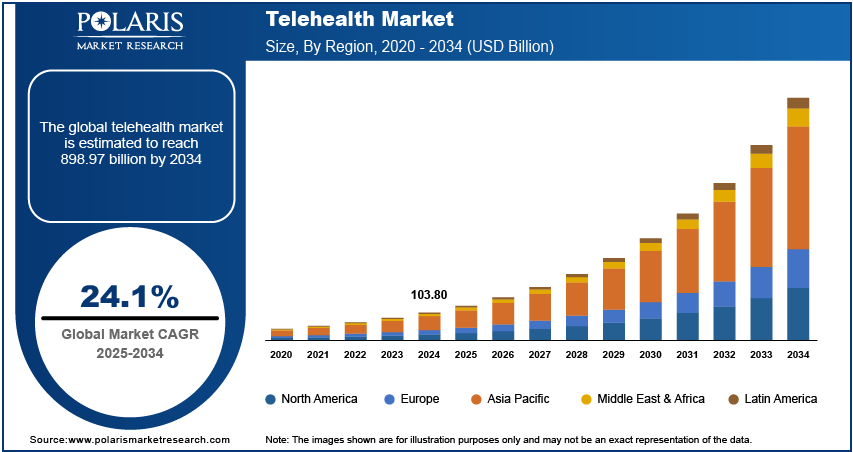
(Source: POLARIS Market Research)
Mobile Healthcare Trends
- Gamification that Encourages Healthier Behavior: Mobile healthcare applications increasingly use gamification to support long-term behavior change. Often compared to ‘Tamagotchis for humans’, these experiences turn health management into an interactive process where users actively care for themselves. By rewarding consistency in physical activity, medication adherence, hydration, and sleep, apps create playful accountability that keeps users engaged. Rather than relying on passive tracking alone, gamified systems reinforce positive habits through motivating feedback loops.
- Location-Aware Healthcare through Geofencing: Geofencing allows mobile healthcare apps to respond intelligently to a user’s location, adding real-world context to care delivery. These features can support emergency response through real-time location sharing, recommend nearby physicians or pharmacies, and trigger reminders when users are close to healthcare facilities. In medication management, geofencing enables timely refill prompts, reducing gaps in treatment and improving adherence.
- Remote Mental Health Monitoring via Wearables: Wearable-integrated mental health applications are moving beyond self-reported check-ins to continuous physiological monitoring. By tracking sleep, stress, respiration, and skin response, these apps can detect early signs of psychological distress. AI-driven pattern recognition helps interpret this data over time, enabling dynamic interventions and proactive alerts that encourage professional support before issues escalate.
- Cloud-Based Mobile Access to EHR and EMR: Patients increasingly expect unified, easy access to their health records. Mobile access to cloud-based electronic health and medical records reduces fragmentation by consolidating data from multiple providers into a single view. This transparency empowers patients to engage more actively in their care, share accurate information during consultations, and maintain continuity as they move between providers or care settings.
Web App Healthcare Trends
- Cloud-Based EHR and EMR Platforms for Providers: Web-based EHR and EMR platforms play a critical role in supporting healthcare professionals. Cloud-hosted systems centralize patient data, scheduling, and documentation, enabling doctors, nurses, and administrative teams to work more efficiently. Streamlined workflows reduce administrative burden and support better continuity of care by ensuring clinicians have timely access to complete patient records.
- Web Portals for Remote Patient Management: Provider-facing web portals are increasingly used to manage patient care remotely. These platforms offer dashboards that track patient metrics in real time, allowing clinicians to monitor progress, identify risks, and intervene when necessary. Medication adjustments and follow-ups can often be handled without in-person visits, while centralized coordination keeps care teams aligned throughout the treatment process.
- Secure Data Sharing Across Healthcare Networks: Effective healthcare delivery depends on collaboration across providers and systems. Web applications now rely heavily on API-driven integrations to enable secure data sharing between platforms. Improved connectivity reduces duplication, minimizes errors, and ensures clinicians have access to accurate information, supporting more coordinated and informed care.
- Scalable Telemedicine Infrastructure: As virtual care continues to expand, telemedicine platforms must be built to scale reliably. Web applications are designed to support high consultation volumes while maintaining performance, security, and compliance. Scalable infrastructure ensures that telehealth systems can grow alongside patient demand and evolving care models without compromising reliability or user experience.
How These Trends Impact Physicians
The telemedicine and telehealth future trends shaping digital healthcare are having a direct impact on how physicians deliver care and manage their workloads.
Automation within healthcare applications is helping reduce administrative burden by streamlining documentation, scheduling, and routine follow-ups, allowing clinicians to focus more of their time on patient care.
Access to richer, real-time data from remote monitoring tools and interoperable health records supports more informed clinical decision-making, particularly for chronic and preventive care.
These trends also enable more flexible care delivery models, allowing physicians to balance virtual and in-person consultations based on clinical need.
Improved digital follow-up tools strengthen continuity of care by making it easier to monitor patient progress between visits, identify issues earlier, and intervene before conditions escalate, ultimately supporting better outcomes for both clinicians and patients.
How These Trends Impact Patients
Telehealth and telemedicine future trends are reshaping the patient experience by making healthcare more accessible, responsive, and personalized. Patients can access care more easily through virtual consultations and mobile health tools, reducing barriers related to location, mobility, and scheduling.
Continuous data collection and personalized insights enable care experiences that reflect individual health patterns rather than one-size-fits-all recommendations. These digital tools also increase patient engagement and accountability by encouraging active participation in health management through monitoring, reminders, and feedback.
With better access to health records and real-time data, patients benefit from faster, more informed medical interventions, allowing concerns to be addressed earlier and treatment decisions to be made with greater confidence and clarity.
Developing an App for the Healthcare Industry
Building digital solutions for the healthcare industry requires far more than technical execution. Healthcare applications operate within complex ecosystems where security and regulatory compliance, as well as data interoperability and user experience must work together seamlessly.
Patient data must be protected at every touchpoint, systems must integrate reliably with existing healthcare infrastructure, and interfaces must be intuitive enough to support both patients and clinicians in high-pressure environments.
These demands make healthcare app development uniquely challenging, particularly as telehealth and remote care continue to expand.
Custom software development plays a critical role in addressing these challenges. Off-the-shelf solutions often struggle to accommodate specialized workflows, regulatory requirements, or evolving care models. Purpose-built healthcare applications, by contrast, can be designed around specific clinical needs, user behaviors, and long-term scalability, ensuring that digital tools enhance care delivery rather than complicate it.
At AppIt, we bring deep experience in developing secure, scalable web and mobile applications for complex industries, including healthcare. Our approach combines robust architecture, thoughtful UX design, and a strong focus on interoperability to support reliable, future-ready solutions.
If you’re exploring a custom healthcare or telehealth application, contact AppIt to discuss how we can help turn your vision into a secure, high-impact digital product.