

Manufacturing is becoming more data-driven than ever before. Companies face constant pressure to reduce costs, improve throughput, and respond quickly to changing customer demands. Traditional systems and manual processes often struggle to keep up, creating inefficiencies and costly errors.
Enterprise resource planning (ERP) designed specifically for the manufacturing industry addresses these challenges by connecting production, supply chain, inventory, and finance into a single, real-time system. From streamlining workflows to improving visibility and decision-making, modern ERP empowers manufacturers to optimize every stage of their operation.
In this article, we explore how manufacturing-focused ERP solves industry-specific challenges, the key features it must include, and why custom ERP solutions deliver measurable results that off-the-shelf tools simply cannot.
The Reality of ERP for the Manufacturing Industry
Enterprise resource planning for the manufacturing industry is fundamentally different from ERP in any other sector. In manufacturing, ERP serves as the operational backbone that connects the shop floor with the supply chain, procurement, engineering, quality teams, and ultimately finance. It brings together every moving part of production (from raw material intake and machine utilization to work-in-progress (WIP) tracking, scrap rates, and delivery timelines) into a single source of truth.
Manufacturers also depend on real-time data in ways most businesses don’t. A machine failure, stockout, or incorrect Bill of Materials (BOM) revision can halt production immediately, so ERP must provide instant visibility into equipment performance, material availability, and workflow status.
This is why off-the-shelf ERP systems often fall short. Highly engineered processes, custom routing, specialized equipment, and unique quality requirements demand flexible, deeply tailored workflows.
As manufacturers move further into Industry 4.0, ERP must also integrate with sensors, PLCs, IoT devices, and data systems to enable truly connected production environments.
Challenges of Enterprise Resource Planning in the Manufacturing Industry
Manufacturing environments operate with a level of complexity and volatility that pushes traditional ERP systems to their limits. Production isn’t linear, data changes constantly, and even small disruptions create downstream effects that impact schedules, costs, and customer commitments.
Below are the core challenges ERP must solve in order to be truly effective for manufacturers.
- Unstable schedules: Production plans shift constantly due to rush orders, machine failures, last-minute changes, and fluctuating customer expectations. ERP must reallocate labor, materials, and timelines in real time without creating new bottlenecks.
- Complex BOMs: Multi-level bills of materials, frequent engineering change orders, and strict revision control require absolute accuracy. If ERP cannot track engineering updates instantly, manufacturers risk rework, scrap, incorrect builds, and inconsistent product quality.
- Disconnected systems: Many factories use MES, SCADA, CMMS, and spreadsheets independently. When ERP cannot integrate these systems, data remains siloed and decision-making is based on incomplete or outdated information.
- Limited WIP visibility: Supervisors often lack real-time insight into where jobs are stalled, how long queues are, or why equipment has stopped. Without visibility into work-in-progress and downtime, throughput declines and schedule accuracy suffers.
- Supplier variability: Long lead times, inconsistent delivery performance, and raw material shortages can halt production. ERP must help track supplier reliability, actual lead times, and the impact of delays on scheduling and procurement.
- Quality issues: Manual inspections, spreadsheets, and slow nonconformance reporting make it difficult to identify root causes. ERP must support automated QC workflows to reduce cost-of-poor-quality (COPQ) and prevent repeat issues.
- Capacity constraints: Manufacturers face limitations in both labor availability and machine uptime. ERP must model true production capacity (considering shifts, maintenance, aging equipment, and skills gaps) to prevent inaccurate planning.
- Forecasting caps: Demand forecasting is difficult due to seasonality, long sales cycles, and supply chain volatility. ERP must incorporate historical trends and real-time data to avoid stockouts, overproduction, and missed deadlines.
- Traceability and compliance: Manufacturers must track every component through production and shipment. Without end-to-end traceability, audits, customer claims, and recalls become costly and time-consuming.
Modern ERP must address each of these challenges with accurate data, real-time insights, and tools designed specifically for the complexity of manufacturing operations.
The Solution to the Challenges Faced in Manufacturing
For manufacturers, ERP becomes transformative when it extends beyond traditional record-keeping and functions as a fully integrated control layer for supply chain, inventory, and production operations. The goal is not only to centralize data, but to create a connected ecosystem where every decision (from procurement to scheduling to shipment) is informed by real-time conditions on the shop floor.
When ERP is built with manufacturing complexity in mind, it directly addresses the operational, forecasting, and visibility challenges that disrupt production and drive up costs.
Enterprise Resource Planning for the Supply Chain
ERP strengthens the manufacturing supply chain by replacing guesswork with precise, data-driven insights.
Supplier performance tracking becomes continuous rather than reactive, giving manufacturers clarity around lead-time accuracy, delivery consistency, defect rates, and overall risk scoring. This allows teams to diversify suppliers, renegotiate terms, or adjust schedules based on real historical patterns rather than assumptions.
ERP also triggers automated procurement activities based on production schedules, BOM requirements, and live inventory status, ensuring materials arrive exactly when needed; without accumulating unnecessary stock.
A manufacturing-ready ERP provides real-time visibility into material availability, allowing planners to evaluate whether upcoming jobs can run as scheduled or whether alternative routing or substitutions are required.
Integrated logistics and freight management add another layer of control, offering transparency over inbound shipments, carrier performance, and delivery ETA accuracy. These capabilities reduce the likelihood of stockouts caused by upstream delays.
Predictive analytics also play a critical role by forecasting shortages, price fluctuations, and supply constraints before they occur, allowing manufacturers to adjust order quantities, reserve stock, or modify schedules proactively.
Enterprise Resource Planning for Inventory Management
Manufacturing inventory complexity goes far beyond retail. ERP must track raw materials, work-in-progress, and finished goods simultaneously, each with different turnover behaviors, storage rules, and production dependencies.
A manufacturing-focused ERP enables complete visibility across multiple warehouses, staging areas, and production lines, giving operations teams accurate insight into not just what inventory exists, but where it physically resides, and how quickly it is being consumed.
BOM-driven inventory consumption ensures materials are allocated precisely according to production requirements, reducing errors and preventing shortages during critical runs. Safety stock calculations become far more accurate when ERP uses actual production data, cycle times, and supplier lead-time variability rather than static formulas.
Automated cycle counting maintains accuracy without disrupting daily operations, while barcode or RFID integration ensures real-time updates as materials move through receiving, storage, and production.
These capabilities help manufacturers reduce excess inventory, free up working capital, and eliminate costly production stoppages caused by missing components.
Manufacturing Enterprise Resource Planning Software: Features That Matter
The right ERP software must unite engineering, production, supply chain, quality, labor, and finance into a single operational ecosystem, while adapting to the realities of machine downtime, complex BOM structures, and rapidly shifting production priorities.
Below are the must-have ERP features built specifically for manufacturing environments.
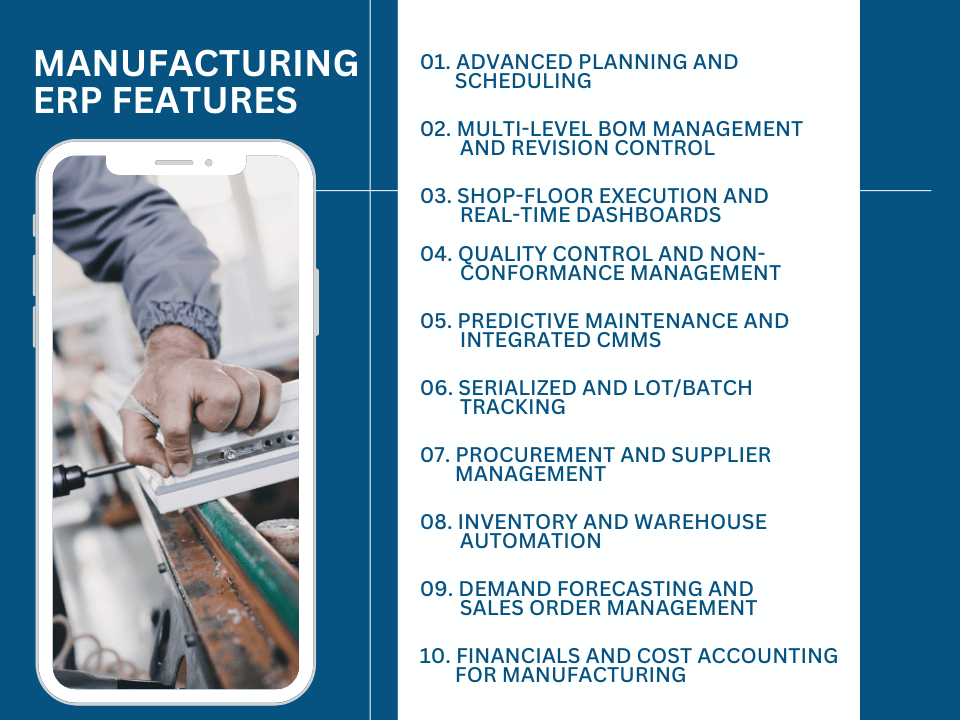
- Advanced planning and scheduling (APS): APS allows manufacturers to build accurate production schedules by factoring in machine availability, labor constraints, setup times, tooling requirements, and real-time capacity. Unlike basic scheduling tools, APS dynamically adjusts plans when a machine goes down, a rush order arrives, or a material delay occurs. This reduces bottlenecks, improves on-time delivery, and ensures that production runs in the most efficient sequence possible.
- Multi-level BOM management and revision control: Manufacturing ERPs must support complex, layered BOM structures with full two-way integration into engineering workflows. With robust revision control, every production order reflects the correct version of a part, assembly, or subassembly. This eliminates errors caused by outdated specs, reduces rework, and ensures seamless alignment between engineering and the shop floor.
- Shop-floor execution and real-time dashboards: Real-time visibility is essential in manufacturing. ERP-connected shop-floor execution systems display live data on machine utilization, cycle times, scrap, WIP status, and job progression. Supervisors can identify bottlenecks instantly, operators receive updated instructions automatically, and management gains accurate insights into performance, throughput, and downtime.
- Quality control and non-conformance management: Integrated QC modules ensure inspections, audits, and test results are captured at every stage of production. Automated non-conformance workflows help teams trace root causes, assign corrective actions, and track resolution. This significantly lowers COPQ and improves compliance with industry standards.
- Predictive maintenance and integrated CMMS: When ERP incorporates maintenance scheduling and predictive analytics, manufacturers can optimize machine uptime and reduce unplanned breakdowns. Integrated CMMS data (including equipment history, sensor readings, and wear patterns) helps maintenance teams plan interventions before failures occur.
- Serialized and lot/batch tracking: Serialization and batch tracking ensure complete traceability of every material, component, and finished product. Manufacturers can instantly locate defective batches, isolate affected units, and respond quickly to audits or recall events. This is crucial for industries with strict regulatory or customer requirements.
- Procurement and supplier management: ERP automates procurement based on real-time demand, actual lead times, and production schedules. Supplier scorecards provide insight into delivery reliability, pricing trends, quality issues, and long-term performance, enabling more accurate planning and improved supplier relationships.
- Inventory and warehouse automation: Automated material movements, barcode/RFID scanning, and optimized picking routes reduce errors and accelerate operations. ERP ensures inventory levels match production needs in real time, preventing both shortages and overstocking while supporting multi-warehouse environments.
- Demand forecasting and sales order management: Accurate forecasting is critical for planning production, staffing, and procurement. ERP uses historical trends, market data, and live sales pipelines to predict demand more accurately. Integrated sales order management ensures customer commitments align with real production capacity.
- Financials and cost accounting for manufacturing: Manufacturing ERPs offer granular visibility into job costing, overhead allocation, scrap impact, labor productivity, and cost-per-unit. This helps leadership identify profit drains, refine pricing strategies, and understand the true cost of production.
How ERP Directly Reduces Costs and Improves Throughput in Manufacturing
When manufacturers adopt a fully integrated ERP system, the financial and operational impact becomes visible almost immediately. Automated, data-driven processes reduce waste, speed up production, and give teams the information they need to make faster, more confident decisions.
ERP reduces scrap rates by ensuring accurate BOM usage, controlled revisions, and consistent quality checks at every stage of production. Machine downtime decreases as maintenance becomes predictive rather than reactive. With real-time scheduling and production visibility, on-time delivery rates rise and labor and equipment are used more efficiently.
Lead times shorten thanks to better planning and material coordination, while improved forecasting accuracy prevents costly over- or under-production. ERP also cuts manual errors and admin work, giving supervisors immediate access to performance insights that keep the plant running smoothly.
Why Custom ERP Development Solves Problems Off-the-Shelf Tools Cannot
Manufacturers rarely operate in a one-size-fits-all environment, yet most off-the-shelf ERP systems are built exactly that way; generic, rigid, and designed for broad use cases rather than specialized production.
Custom ERP software development addresses this gap by aligning the software directly with the realities of fabrication, machining, assembly, and other complex manufacturing workflows. Instead of forcing teams to adapt to a system’s limitations, the system adapts to them.
A custom ERP can integrate seamlessly with the technologies that keep a plant running: PLCs, CNC machines, sensors, SCADA environments, legacy databases, and any other equipment essential to day-to-day operations. This eliminates data silos and creates true real-time visibility across the factory floor.
For manufacturers with multiple plants, flexibility becomes even more important. Custom development supports unique process variations, location-specific rules, and shared data models, without compromising standardization where it matters.
It also allows organizations to own their IP, ensuring long-term scalability as production volumes grow, product lines evolve, or new capabilities are added.
Role-specific dashboards are another advantage. Whether it’s a production manager needing live throughput data, a scheduler seeking capacity insights, or a CFO monitoring cost performance, custom ERP ensures every decision-maker gets exactly the information they need.
AppIt’s Approach to Building ERP for the Manufacturing Industry
At AppIt, we know that manufacturing success depends on precision, reliability, and seamless coordination across the entire production process. That’s why our ERP development approach begins with a deep discovery phase focused on mapping every workflow; on the floor, in the warehouse, and across the supply chain. We take the time to understand how your teams operate today so we can design software that supports them tomorrow.
Instead of forcing you into a rigid new system, we build custom ERP architectures that integrate with the systems you already rely on, including machines, sensors, PLCs, databases, and legacy tools. This reduces disruption and preserves the investments you’ve already made.
Our design process is intentionally user-centric, ensuring that operators, supervisors, planners, and executives all get intuitive, shop-floor-friendly interfaces that make work easier, not more complicated. Behind the scenes, we engineer for stability, uptime, and long-term scalability, so your ERP grows with your production demands.
We also stay engaged beyond deployment. Our team provides ongoing maintenance, version improvements, and a structured roadmap for continuous enhancement as your manufacturing environment evolves.
If you're ready to build an ERP system that truly fits your operation, contact us at AppIt for custom software development.