

Software problems rarely appear without warning. Slow performance, security vulnerabilities, recurring bugs, and scalability issues often begin deep within an application’s source code long before they impact customers or business operations. As companies become more dependent on software to drive growth, the quality and stability of that code become increasingly important.
This is where code auditing in software testing plays a critical role. By evaluating the structure, security, and maintainability of an application’s codebase, businesses can identify hidden risks early and make more informed technology decisions.
Whether preparing for growth, modernizing legacy systems, or improving software reliability, understanding how source code audits work can help organizations reduce risk and build stronger digital products.
In this article, we break down what source code auditing involves, why it matters, and how businesses can use it to support long-term software success.
What Is Code Auditing in Software Testing?
Code auditing in software testing is the process of reviewing an application’s source code to identify issues that could affect software quality, security, performance, and long-term reliability.
In simple terms, it involves carefully examining how software has been built to uncover vulnerabilities, inefficiencies, compliance concerns, and maintainability challenges before they become larger business problems.
The process of auditing the source code for an application is an important part of modern quality assurance because it helps development teams evaluate whether software is functioning as intended behind the scenes, not just from the user’s perspective. Unlike basic testing that focuses on how an application behaves, source code auditing looks directly at the structure and logic of the code itself.
Code auditing in software testing is not limited to large enterprises or highly regulated industries either. Businesses of all sizes can use source code auditing to better understand the overall health and stability of their software systems.
Why Source Code Quality is Important
High-quality source code plays a major role in how reliable, secure, and scalable a software application becomes over time. When code quality is poor, businesses often experience issues that extend far beyond technical frustration and directly affect operations, revenue, and customer confidence.
Even small coding problems can grow into larger business risks when they are left unresolved for long periods. This is why many organizations now prioritize code quality auditing as part of maintaining healthy, sustainable software systems.
Poor code quality can impact businesses in several ways, including:
- increased security vulnerabilities that may lead to data exposure or compliance concerns
- slower application performance that affects user experience and productivity
- scalability limitations that make growth more difficult and expensive
- rising maintenance costs due to repeated fixes and unstable systems
- reduced customer trust when software becomes unreliable or experiences downtime
- delays in development cycles and longer time-to-market for new features.
When these issues accumulate, technical debt grows rapidly, making future updates more complex and costly. In severe cases, companies may face operational inefficiencies, expensive rebuilds, lost revenue, or reputational damage that could have been avoided with stronger code quality from the beginning.
What a Source Code Audit Looks For
A source code audit looks beyond whether software simply works as expected in the present moment. It evaluates the overall health, stability, and sustainability of an application to identify issues that could create risks over time.
During the review process, part of what auditors look for is coding patterns, inconsistencies, or design decisions that may lead to future instability, higher maintenance costs, or operational disruptions.
Key areas typically evaluated during a source code audit include the following.
- Security vulnerabilities: Reviewing the code for weaknesses that could expose systems to cyber threats, unauthorized access, or sensitive data breaches.
- Code structure and readability: Assessing how clearly and consistently the code is organized to ensure it can be understood and managed efficiently by development teams.
- Performance bottlenecks: Identifying sections of code that may slow down the application, reduce responsiveness, or impact system efficiency under heavier usage.
- Error handling: Evaluating how the software responds to failures, unexpected inputs, or system interruptions to reduce the risk of crashes and instability.
- Dependency risks: Checking third-party libraries, frameworks, and integrations that could introduce vulnerabilities or compatibility concerns.
- Compliance concerns: Reviewing whether the application aligns with industry standards, internal policies, or regulatory requirements.
- Maintainability: Determining how easily the software can be updated, expanded, debugged, and supported in the future as business needs change.
The Different Types of Code Audits
Different software projects require different approaches to evaluating code quality, security, and long-term stability. As a result, organizations typically use one of three main approaches to code auditing depending on the complexity of the application, project timelines, and overall business requirements.
Manual Code Audits
Manual code audits involve experienced developers reviewing source code directly to identify potential issues, weaknesses, and areas of concern. This human-led approach allows auditors to apply contextual understanding, evaluate business logic, and identify subtle coding problems that may not be immediately obvious through automated scanning alone.
Manual reviews are particularly useful when assessing complex workflows, architectural decisions, or application-specific functionality.
However, because developers must carefully inspect large sections of code, this process can require significant time and resources, especially for larger applications with extensive codebases.
Automated Code Audits
Automated code audits use specialized source code audit tools to scan applications quickly and consistently for known risks and coding concerns.
These systems often rely on static analysis, which means they examine the source code itself without actually running the application. During the scan, automated systems can flag issues such as insecure coding patterns, syntax problems, inefficient logic, or outdated dependencies.
Because automated audits can process large volumes of code efficiently, they are commonly used in fast-paced development environments where ongoing monitoring is important. Their speed and consistency also make them useful for identifying repetitive or standardized issues across projects.
Hybrid Code Audits
Hybrid code audits combine manual expertise with automated analysis to create a more comprehensive evaluation process. Many modern development teams prefer this approach because it balances human insight with the efficiency of automation.
Automated systems can quickly identify common technical concerns, while experienced developers provide deeper analysis, interpret findings in context, and evaluate more complex application behavior. This combined approach often provides broader visibility into both technical risks and overall software quality.
Source Code Audits vs Code Reviews
Although source code audits and code reviews both involve examining software code, they serve different purposes within the software development process.
Code reviews are typically collaborative exercises performed by developers during active development. Their primary goal is to improve code quality, maintain coding standards, share knowledge between team members, and identify issues early before new code is merged into a project. These reviews usually occur continuously throughout development and focus on day-to-day improvements.
Source code audits, on the other hand, are more formal evaluations designed to assess deeper risks related to security, stability, compliance, and long-term maintainability. Audits are often conducted at key business or operational stages, such as before deployment, scaling, or modernization projects. They also tend to involve senior specialists, technical leads, security professionals, or external partners rather than only internal development teams.
While the processes differ in timing, objectives, depth, and stakeholders involved, they ultimately complement one another as part of a broader software quality strategy.
The Benefits of Source Code Audit for Growing Businesses
As software systems grow alongside a business, maintaining code quality becomes increasingly important for long-term success. One of the key benefits of source code audit processes is that they help organizations identify risks early while improving the overall reliability and sustainability of their applications.
Other benefits of source code audits include the following.
- Improved security posture: Source code audits help uncover vulnerabilities that could expose applications to cyber threats, unauthorized access, or sensitive data breaches before they become serious incidents.
- Reduced development risk: By identifying hidden coding issues early, businesses can reduce the likelihood of failed deployments, unstable releases, or unexpected technical setbacks during growth phases.
- Better software stability: Audits help ensure applications operate more consistently by detecting weaknesses that may lead to crashes, downtime, or inconsistent performance under real-world conditions.
- Faster future development cycles: Cleaner, better-structured code allows development teams to work more efficiently when adding features, making updates, or troubleshooting problems in the future.
- Easier scalability: As user demands increase, applications need to scale without sacrificing performance. Audits can reveal structural limitations that may create obstacles as systems expand.
- Lower maintenance costs: Applications with fewer hidden issues are typically easier and less expensive to maintain over time, reducing the need for constant reactive fixes and emergency support.
- Improved compliance readiness: For businesses operating in regulated industries, audits can help identify areas where applications may not align with security standards, internal policies, or industry requirements.
- Greater investor and client confidence: Well-maintained software demonstrates operational maturity and reliability, helping businesses build trust with investors, stakeholders, customers, and potential partners who depend on secure, stable technology systems.
When Companies Typically Need a Source Code Audit
Businesses often conduct source code audits during periods of change, growth, or increased operational risk. These evaluations help organizations better understand the condition of their software before making important technical or business decisions.
Audits are especially valuable for legacy systems and fast-growing applications, where hidden issues can become more difficult and expensive to manage over time.
Common scenarios where companies typically require a source code audit include:
- Before launching a new product or platform
- During rapid business or user growth
- After acquiring third-party software or another company’s technology
- Prior to investor due diligence or funding discussions
- Following recurring software bugs, outages, or performance concerns
- Before cloud migration, modernization, or system transformation projects
- During regulatory or compliance preparation processes
In many cases, businesses seek audits when they need greater visibility in software quality, security risks, or long-term maintainability. Fast-moving development environments and aging systems often contain hidden technical concerns that may not be obvious until they begin affecting scalability, operational efficiency, or future development plans.
Choosing the Right Source Code Audit Service
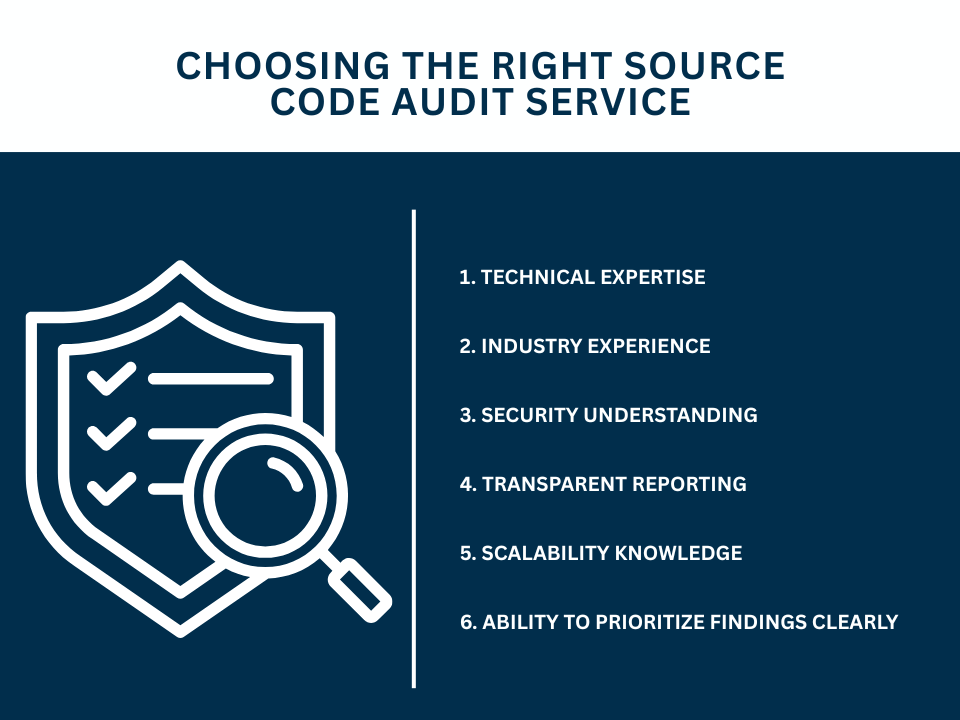
Selecting the right source code audit service requires more than simply choosing a provider with technical capabilities.
Businesses should look for teams that combine strong development expertise with practical industry experience, security knowledge, and a clear understanding of how software supports broader business goals. A reliable provider should be able to evaluate complex systems thoroughly while also delivering transparent reporting that stakeholders can easily understand.
It is also important to choose a partner with scalability knowledge, particularly for businesses planning future growth, modernization, or expansion. Strong audit providers prioritize findings clearly, helping organizations understand which issues require immediate attention and which can be addressed over time.
Business context matters just as much as technical analysis because software challenges often affect operational efficiency, customer experience, and long-term strategy. Rather than overwhelming clients with highly technical reports, an effective source code audit service should provide actionable recommendations that support smarter decision-making and practical next steps.
Why Code Auditing Should Be Part of Long-Term Software Strategy
Code auditing should not be treated as a one-time activity completed only before a product launch or major release. Modern software environments evolve constantly through new features, integrations, user demands, and security challenges, which means ongoing quality assurance has become essential for maintaining stable and reliable systems.
Regular auditing allows businesses to continuously monitor software health, identify emerging risks early, and maintain stronger development standards as applications grow more complex over time.
As part of a long-term software strategy, consistent code auditing supports continuous improvement by helping teams refine code quality and development practices over multiple release cycles. It also plays an important role in secure scaling, allowing applications to expand without introducing unnecessary vulnerabilities or instability.
By reducing technical obstacles and identifying maintainability concerns early, regular audits can also support faster innovation and reduce long-term technical debt.
Ultimately, integrating code auditing into sustainable software development practices helps businesses create software systems that remain adaptable, secure, and easier to manage in the future.
Building Better Software with the Right Development Partner
As businesses become increasingly dependent on digital systems, software quality, security, and long-term stability have become critical to operational success. Code auditing plays an important role in helping organizations identify hidden risks, improve maintainability, and strengthen overall software performance before issues become costly business problems.
However, navigating technical complexity can be challenging without the right expertise and development support in place.
AppIt helps businesses simplify this process by providing expert custom software development, testing, and code auditing services tailored to long-term business goals.
With experience developing scalable, high-performing software solutions, AppIt works closely with organizations to identify risks early, improve software quality, and build applications designed for future growth.
Whether a business is launching a new platform, modernizing legacy systems, or scaling an existing application, having the right development partner can make a significant difference in long-term success.
Contact AppIt today to learn how expert software auditing and development support can help your business build secure, reliable, and future-ready software solutions.